Association Between School
Neighborhood Walkability and Adolescent Physical Activity
Brooke E.
Wagner1,2, Zili Zong3, Cody D. Neshteruk1,2, and Emily
M. D’Agostino1,2,4,5,6
1 Department of Population Health Sciences, Duke
University School of Medicine, U.S.A.
2 Duke Center for Childhood Obesity
Research, Duke University School of Medicine, U.S.A.
3 Department of Biostatistics and
Bioinformatics, Duke University, U.S.A.
4 Department of Orthopaedic Surgery, Duke University School of Medicine, U.S.A.
5 Duke Clinical Research Institute,
Duke University School of Medicine, U.S.A.
6 Duke Global Health Institute, Duke
University School of Medicine, U.S.A.
Abstract
Neighborhood structural
factors are associated with greater feasibility of youth active travel and
thus, greater levels of physical activity. However, limited prior work has
addressed walkability factors specific to the school neighborhood related to
adolescent physical activity during the school day. Therefore, the purpose of
this study was to examine the relationship between two school
neighborhood walkability factors (neighborhood density and neighborhood age)
and school-related adolescent MVPA). We analyzed cross-sectional data from the
Family Life,
Activity, Sun, Health, and Eating (FLASHE)
study for 1,183 adolescents ages 12-17 years.linear regression models assessed the association
between both (i.e., population/housing unit density and age of buildings/units,
respectively, within a 400m buffer around school address) and , adjusting for ge, sex,
race/ethnicity, weight status, urban/rural environment and parent MVPA. neighborhood density (8.62, 95% CI: 0.70, 16.53) and
school-neighborhood age (6.38, 95% CI: -0.29, 13.05) were both positively
associated with school-related MVPA, although the neighborhood age-MVPA
association observed was not statistically significant. When seeking to improve physical activity among adolescents, school neighborhood structural factors that support
physical activity throughout a school day should be considered. Unfortunately, macro-scale
environmental features such as these are not easily modified. Thus, these findings should be used to inform additional
research related to school-neighborhood walkability and adolescent
participation in physical activity.
Keywords: Adolescent
Health, Physical activity, Walkability, School-Neighborhood, Moderate-to-vigorous physical activity
Routine youth physical activity (PA) supports healthy
habits early in life, with lasting benefits into adulthood, including
protection against cardiometabolic risk factors like high blood pressure,
obesity, and diabetes (World Health Organization, 2024). The World Health
Organization (WHO) recommends that youth ages 6-17 years engage in 60 minutes
of moderate-to-vigorous PA (MVPA) every day (WHO, 2004). However, steep declines in MVPA are observed in
adolescence, particularly among racial/ethnic minorities, resulting
in only 7% of US youth ages
12-15 years and 5% of US youth ages 16-19 years meeting PA guidelines
(Rodriguez-Ayllon et al., 2019; Allison et al., 2007; Armstrong et al., 2018;
Belcher et al., 2010; Katzmarzyk et al., 2018). This presents a critical need to identify factors that may improve adolescent MVPA.
The neighborhood built environment around the home can
play an important role in promoting PA among youth. In particular, factors
impacting walkability and greater diversity of land-use (i.e., the broad mix of
residential, commercial, and office spaces within a walkable distance) of a
neighborhood have been shown to be positively associated with PA and active
transportation (Ding et al., 2011; Kligerman et al., 2007; Frank et al., 2007).
Residential (population and housing)
density and neighborhood age are two important and widely used indicators of
neighborhood walkability among both youth and adults (Berrigan & Troiano,
2002; Boer et al., 2007; Smith et al., 2008; Kowaleski-Jones et al., 2017). Greater neighborhood residential density may increase
walking patterns if more people are seen walking throughout the neighborhood,
and may coincide with greater land use mix and more destinations within walking
distance. Additionally, older neighborhoods promote walkability as they were more
likely to have been designed with a pedestrian friendly focus with more features
like sidewalks, interconnected street networks, and more commercial areas
within close proximity (i.e., land use diversity) (Molina-Garcia, Garcia-Masso,
et al., 2019).
While the diversity of land use and walkability factors
around the home neighborhood environments show promising benefits for PA
behaviors among adolescents, especially on weekends, it is less
clear if environmental factors around the school neighborhood play a similar
role (Loh et al., 2020). Given the amount of time youth spend at school, and also
traveling each day to and from school, the built environment around the school
may play an important role in supporting and promoting PA among this age group
especially on school days. One prior study suggests that the school
neighborhood environment may be associated with youth MVPA outside of school
hours, while land use mix was negatively associated with school day MVPA. Additional studies have found that the built environment
and walkability of the area surrounding the school (measured through neighborhood
density, street intersection density, land use mix, and other micro-scale
environment factors such as streetscape features) may specifically promote
active transportation to and from school and thus overall PA (Braza et al.,
2004; Molina-Garcia, Campos et al., 2020; Panter et al., 2010; Carlson et al.,
2014; Davidson et al., 2008; Faulkner et al., 2013; Lubans et al., 2011). While
transportation to and from school may play a large role in youth PA during
school days, additional opportunities for engagement include physical education
(PE) and recess which may also be impacted by the built environment around the
school. Still, limited prior work has assessed how the built environment and
walkability may be associated with school time PA overall.
Therefore, this study aimed to examine the
relationship between two school-neighborhood built environment factors
associated with walkability (neighborhood density and neighborhood age) and
total time per week adolescents spent engaging in school-related MVPA,
including active transportation, recess, physical education, and other PA
opportunities throughout a school day. With a more nuanced understanding of the
relationship between environmental factors and PA beyond the immediate home
environment, this work can inform future youth PA promotion initiatives related
to city planning, land use, and community design around school environments.
Methods
We conducted a cross-sectional analysis of publicly
available data from The Family Life, Activity,
Sun, Health, and Eating (FLASHE) study, conducted by the National Cancer
Institute (NCI) (NCI, 2020a). The sample was drawn from a Consumer Opinion
Panel using a balanced sampling method so that the sample demographic
characteristics closely match with the general US population (including gender,
race/ethnicity, household income and size, and census division (NCI, 2018). The FLASHE Study was approved by Westat, Inc., and NCI
Special Studies Institutional Review Boards. Adolescents ages 12 to 17 years
old with complete demographic information (sex, age, height and weight, and
race/ethnicity), school environments, and PA measures were included (see
Supplemental Figure 1 for more data collection detail).
Measures
The primary exposures were two school-neighborhood walkability factors:
school-neighborhood density (population/housing unit
density) and school-neighborhood age (age of buildings/units) within a 400m
buffer around each participant’s school address. Neighborhood information and youth
residential addresses were Geocoded by the FLASHE study to develop the
neighborhood and contextual variables to be linked to youth survey data. School-neighborhood
density and school-neighborhood age were derived using principal component
analysis from all census tracts in the U.S. (Hoehner et al., 2011). Higher
values for each factor are associated with greater density and older
neighborhoods, and are hypothesized to correspond with more conducive walking
environments Additional information on the
methods used to estimate the buffer zone and construct these variables are
described in detail in the FLASHE data user technical report.
The primary outcome for this study was adolescent
school-related moderate to vigorous PA, a summary measure of all items
reflecting PA during school hours (PE, recess, lunch time activity, and active
transportation to and from school) (NCI, 2020b). PA was self-reported using the Youth Activity Profile, and MVPA was obtained by weighting individual items for
school-related PA using a previously derived calibration procedure, which
allows raw composite scores of each activity type to be converted to an
estimate of relative time in minutes spent per day in school-related MVPA.
Statistical Analysis
Descriptive statistics including means and standard
deviations for continuous variables and frequencies and percentages for
categorical variables were calculated to describe the sample and exposure
variables. Chi-squared tests were used to compare the distribution of
categorical variables (age, sex, race/ethnicity, weight status [based on age-
and sex-adjusted body mass index], and urban/rural environment) across
school-neighborhood walkability factors (neighborhood density and neighborhood
age).
Cut points with roughly equal proportions of the
populations in each subgroup for all US census tracts were calculated and
applied to each school-neighborhood walkability factor at school locations to
yield tertiles (low, medium and high). Analysis of variance (ANOVA) was used to
compare means of MVPA across school-neighborhood walkability factor tertiles. Adjusted models included adolescents’ demographics
(age, sex, race/ethnicity, weight status and urban/rural environment) and
parent MVPA (collected by self-report, and included due to the well-documented
association between parent and child PA),17 as covariates. A
significance level of 0.05 was used for all analyses. All statistical analyses
were conducted using R Studio 1.4.1103.
Results
The total number of participants who had data on
exposure covariates and outcomes was 1,183. The sample included approximately
the same proportion of males and females (50.1% and 49.9%, respectively). Most
adolescents were non-Hispanic White (64.8%) and had either underweight or
healthy weight (73.1%). Most adolescents attended school in the suburbs (43.1%)
or cities (27.6%). The average (mean ±SD) weekly minutes of school-related MVPA
was 289 ±53.0 minutes per week. Additional characteristics of the sample can be
found in Supplemental Table 1.
The descriptive distribution of demographic
characteristics and PA of adolescents across tertiles of school-neighborhood
density and school-neighborhood age are detailed in Supplemental Table 1. Differences
in the distribution of race and ethnicity were observed for both
school-neighborhood density and age, where the majority of participants in low
and medium levels of school-neighborhood density were White, while the higher
density school-neighborhoods were evenly divided between White and non-white
participants (see Supplemental Table 1). Additionally, differences were
observed for the distribution of urban and rural environments of school for
both neighborhood density and neighborhood age. No differences in
school-related MVPA were found between tertiles of neighborhood density or
neighborhood age.
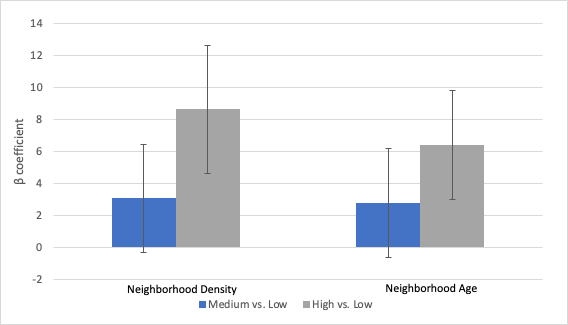
In adjusted models shown in Figure 1,
school-neighborhood density (8.62, 95% CI: 0.70, 16.53) was positively
associated with school-related MVPA, such
that adolescents in the highest tertiles of school-neighborhood density and
school-neighborhood age had higher school-related MVPA compared to adolescents
in the lowest tertiles. School-neighborhood age also
showed a positive relationship with school-related MVPA, although the
association was not statistically significant (6.38, 95% CI: -0.29, 13.05).
Discussion
This study drew data from the FLASHE study to examine the relationship between school-neighborhood walkability
factors and school-related adolescent MVPA. Students attending schools in high density (i.e., ) and neighborhoods with
older age had higher school-related MVPA compared to those attending school in
neighborhoods with low density and younger age. These findings support those
from California Public Schools, in which the neighborhood density around the
school was associated with adolescent PA, though neighborhood age was not
assessed. Contrary to our findings, among a small sample of 417 adolescents in
Australia, the walkability around school-neighborhoods (based on street
intersections, density, and land use mix) was not associated with overall MVPA
on weekdays for adolescents, although associations were found with other school
built environment factors (i.e., number of parks, park areas, and trails).
Differences in these findings compared to our study results may be related to
the specific school-neighborhood built environment factors that were assessed,
making it difficult to directly compare results.
Our current findings also
mirror those assessing residential neighborhood density and age (as opposed to
school neighborhoods), where neighborhood density and age were positively
associated with adolescent PA behavior. Previous studies have suggested that
youth are more likely to walk or bike to school rather than take public
transportation if they live in neighborhoods with decreased proximity between
school and homes (which is often the case in older neighborhoods ), and when
walkability is greater surrounding schools (Christiansen et al., 2014). The
school-related MVPA questions in our current study included the number of days
that youth walk or bike to/from school, thus we may conclude that denser and
older school-neighborhoods improve walkability to allow for more active
transportation and ultimately greater levels of adolescent PA as supported by
previous findings (Larouche et al., 2014). Importantly, Smith and colleagues
found and inverse association between neighborhood age (as a proxy for land-use
diversity) and walkability related risk of obesity among adults. These findings highlight the importance of considering
school neighborhood structural environments when designing health initiatives
to promote active travel to school and access to PA among youth populations,
particularly for adolescents living in urban settings.
This study strengthens
our understanding of the relationship between school-neighborhood walkability
and adolescent PA during the school day. This study also included the use of a
national sample, a validated measure for PA, data driven identification of
school-neighborhood walkability factors, and analyses that accounted for the relationship
between multi-level factors and youth PA. However, several limitations need
acknowledgement. Although the study sample was a nationwide sample, the
demographics are not nationally representative, limiting our ability to
generalize findings to the wider U.S. adolescent population. Additionally, this study was cross-sectional and limited by
sample size. Future research should examine these relationships over time and with
larger samples to provide more precise
and longitudinal estimates. Also,
this study examined just two measures of the school-neighborhood environment.
Other school-neighborhood walkability factors may be important predictors of
youth MVPA, including proximity and density of walking/biking paths, greenspace
and parks, recreation sites and quality of play equipment, and tree cover
(Heath et al., 2012; Sallis et al., 2012). Beyond
walkability, additional factors within the school like types of equipment
offered, green space availability, facility types, and amount of school-based PA
programing offered, were not available in the FLASHE dataset to include in the
analysis, limiting our ability to understand how other important factors might
influence school day PA for youth. Further
research should investigate the association between additional
school-neighborhood walkability and school environment factors and adolescent
MVPA throughout the school day. In addition, data collected from FLASHE were mainly self-reported,
although estimated time spent in MVPA drawing from FLASHE surveys were
statistically equivalent to accelerometer-measured estimates for both
school-based PA in a follow-up study (Saint-Maurice et al., 2017).
Conclusion
Routine youth PA has lasting
cardiovascular and mental health benefits tracking into adulthood, although only 20% of U.S. adolescents meet the recommended
guidelines of at least 60 minutes of MVPA per day. This study examined the relationship
between both school-neighborhood walkability and school-related adolescent PA. Students
attending schools in neighborhoods with high density and older neighborhood age
had higher school-related MVPA compared to those attending school in
neighborhoods with low density and younger age. These findings can be used to support programming and
policies to increase adolescent PA participation and downstream cardiovascular
and mental health benefits across the lifespan.
Corresponding
author
Brooke E.
Wagner
215 Morris St,
Duke University
Durham, NC
27701
brooke.wagner@duke.edu
(989)
600-2496
 Brooke E. Wagner: 0000-0002-8969-3653
Zili Zong: 0000-0002-6828-2388
Cody D. Neshteruk: 0000-0002-0516-6873
Emily M. D’Agostino: 0000-0002-1631-0279
Author Contributions
Conceptualization: all authors
contributed equally; Data curation: E. M. D. and Z. Z.; Formal analysis: E. M.
D. and Z. Z.; Methodology: E. M. D., Z. Z., and C. D. N.; Supervision: E. M. D.
and C. D. N.; Writing – original draft: Z. Z. and B. E. W.; Writing – review
& editing: all authors contributed equally.
Acknowledgements
None.
Creative Commons License
This work is licensed under
a Creative Commons
Attribution-Noncommercial 4.0 International License (CC BY-NC 4.0).
Conflicts of interest
The authors have no conflicts of
interest to disclose.
Funding
This research did not receive
any specific grant from funding agencies in the public, commercial, or
not-for-profit sectors.
References
Allison, K. R.,
Adlaf, E. M., Dwyer, J. J., Lysy, D. C., & Irving, H. M. (2007). The
decline in physical activity among adolescent students: a cross-national
comparison. Canadian journal of public health = Revue canadienne de sante
publique. 98(2):97-100.
Armstrong, S.,
Wong, C. A., Perrin, E., Page, S., Sibley, L., & Skinner, A. (2018). Association
of Physical Activity With Income, Race/Ethnicity, and Sex Among Adolescents and
Young Adults in the United States: Findings From the National Health and
Nutrition Examination Survey, 2007-2016. JAMA pediatrics.
172(8):732-740. doi:10.1001/jamapediatrics.2018.1273
Belcher, B. R.,
Berrigan, D., Dodd, K. W., Emken, B. A., Chou, C. P., & Spruijt-Metz, D. (2010,
December). Physical activity in US youth: effect of race/ethnicity, age,
gender, and weight status. Med Sci Sports Exerc. Dec
2010;42(12):2211-21. doi:10.1249/MSS.0b013e3181e1fba9
Berrigan, D.
& Troiano, R. P. (2022, August). The association between urban form and
physical activity in U.S. adults. Am J Prev Med. 23(2 Suppl):74-9.
doi:10.1016/s0749-3797(02)00476-2
Boer R, Zheng
Y, Overton A, Ridgeway GK, Cohen DA. (2007, April). Neighborhood design and
walking trips in ten U.S. metropolitan areas. Am J Prev Med.
32(4):298-304. doi:10.1016/j.amepre.2006.12.012
Braza, M.,
Shoemaker, W., & Seeley, A. (2004). Neighborhood design and rates of
walking and biking to elementary school in 34 California communities. Am J
Health Promot. 19(2):128-36. doi:10.4278/0890-1171-19.2.128
Carlson, J. A.,
Sallis, J. F., Kerr, J., et al. (2014). Built environment characteristics and
parent active transportation are associated with active travel to school in
youth age 12-15. Br J Sports Med. 48(22):1634-1639. doi:
10.1136/bjsports-2013-093101
Christiansen,
L. B., Toftager, M., Schipperijn, J., Ersboll, A. K., Giles-Corti, B., & Troelsen,
J. (2014). School site walkability and active school transport - association,
mediation and moderation. J Transp Geogr. 34:7-15.
Davison, K. K.,
Werder, J. L., & Lawson, C. T. (2008, July). Children's active commuting to
school: current knowledge and future directions. Prev Chronic Dis.
5(3):A100.
Ding, D.,
Sallis, J. F., Kerr, J., Lee, S., & Rosenberg, D. E. (2011, October). Neighborhood
environment and physical activity among youth a review. Am J Prev Med.
41(4):442-55. doi:10.1016/j.amepre.2011.06.036
Faulkner, G.,
Stone, M., Buliung, R., Wong, B., & Mitra, R. (2013, December 11). School
travel and children's physical activity: a cross-sectional study examining the
influence of distance. BMC Public Health. 13:1166.
doi:10.1186/1471-2458-13-1166
Frank, L.,
Kerr, J., Chapman, J., & Sallis, J. (2007). Urban form relationships with
walk trip frequency and distance among youth. Am J Health Promot. 21(4
Suppl):305-11. doi:10.4278/0890-1171-21.4s.305
Heath, G. W.,
Parra, D. C., Sarmiento, O. L., et al. (2012). Evidence-based intervention in
physical activity: lessons from around the world. The Lancet.
380(9838):272-281. doi:10.1016/s0140-6736(12)60816-2
Hoehner, C. M.,
Handy, S. L., Yan, Y., Blair, S. N., & Berrigan, D. (2011, December). Association
between neighborhood walkability, cardiorespiratory fitness and body-mass
index. Soc Sci Med. 73(12):1707-16. doi:10.1016/j.socscimed.2011.09.032
Katzmarzyk, P.
T, Denstel, K. D., Beals, K., et al. (2018). Results from the United States
2018 report card on physical activity for children and youth. 15(s2):S422-S424.
Kligerman, M.,
Sallis, J. F., Ryan, S., Frank, L. D., & Nader, P. R. (2007). Association
of neighborhood design and recreation environment variables with physical
activity and body mass index in adolescents. Am J Health Promot. 21(4):274-7.
doi:10.4278/0890-1171-21.4.274
Kowaleski-Jones,
L., Fan, J. X., Wen, M., Hanson, H. (2017, September). Neighborhood Context and
Youth Physical Activity: Differential Associations by Gender and Age. Am J
Health Promot. 31(5):426-434. doi:10.1177/0890117116667353
Larouche, R.,
Saunders, T. J., Faulkner, G., Colley, R., & Tremblay, M. (2014, January). Associations
between active school transport and physical activity, body composition, and
cardiovascular fitness: a systematic review of 68 studies. J Phys Act Health.
11(1):206-27. doi:10.1123/jpah.2011-0345
Loh, V. H.,
Veitch, J., Salmon, J., et al. (2020, May). Residential vs school
neighborhoods: Associations with physical activity among adolescents. Health
Place. 63:102328. doi:10.1016/j.healthplace.2020.102328
Lubans, D. R.,
Boreham, C. A., Kelly, P., & Foster, C. E. (2011, January 26). The
relationship between active travel to school and health-related fitness in
children and adolescents: a systematic review. Int J Behav Nutr Phys Act.
8:5. doi:10.1186/1479-5868-8-5
Molina-García,
J., Campos, S., García-Massó, X., et al. (2020). Different neighborhood
walkability indexes for active commuting to school are necessary for urban and
rural children and adolescents. International Journal of Behavioral
Nutrition and Physical Activity. 17(1)doi:10.1186/s12966-020-01028-019.
Molina-Garcia,
J., Garcia-Masso, X., Estevan, I., Queralt, A. (2019). Built environment,
psychosocial factors and active commuting to school in adolescents: Clustering
a self-organizing map analysis. Int J Environ Res Public Health.
16(1):83. doi: 10.3390/ijerph16010083
National
Cancer Institute. (March, 2018). Family Life, Activity, Sun, Health, and Eating
(FLASHE) GeoFLASHE Methods Report. Retrieved August 15, 2021 from
https://cancercontrol.cancer.gov/sites/default/files/2020-06/geoflashe-methods-report-nci.pdf
National
Cancer Institute. (2020a). 2014 Family Life, Activity, Sun, Health and Eating
(FLASHE) Survey Data. Rockville, MD: U.S. Department of Health and Human
Services, National Cancer Institute. Retrieved August 15, 2021 from http://cancercontrol.cancer.gov/brp/hbrb/flashe.html
National
Cancer Institute. (2020b). Guide for Data Users: The Family Life, Activity,
Sun, Health, and Eating Study (FLASHE). Retrieved August 15, 2021 from
https://cancercontrol.cancer.gov/sites/default/files/2020-06/flashe-data-users-guide.pdf.
Panter, J. R.,
Jones, A. P., Van Sluijs, E. M. F., & Griffin, S. J. (2010). Neighborhood,
route and school environments and children’s active commuting. Am J Prev
Med. 38(3). doi: 10.1016/j.amepre.2009.10.040
Rodriguez-Ayllon,
M., Cadenas-Sánchez, C., Estévez-López, F., et al. (2019). Role of Physical
Activity and Sedentary Behavior in the Mental Health of Preschoolers, Children
and Adolescents: A Systematic Review and Meta-Analysis. Sports Medicine.
2019/09/01 2019;49(9):1383-1410. doi:10.1007/s40279-019-01099-5
Saint-Maurice,
P. F., Kim, Y., Hibbing, P., Oh, A. Y., Perna, F. M., & Welk, G. J. (2017).
Calibration and Validation of the Youth Activity Profile: The FLASHE Study. American
Journal of Preventive Medicine. 52(6):880-887.
doi:10.1016/j.amepre.2016.12.01031.
Sallis, J. F.,
Floyd, M. F., Rodriguez, D. A., & Saelens, B. E. (2012, February 7). Role
of built environments in physical activity, obesity, and cardiovascular
disease. Circulation. 125(5):729-37.
doi:10.1161/CIRCULATIONAHA.110.969022
Smith, K. R.,
Brown, B. B., Yamada, I., Kowaleski-Jones, L., Zick, C. D., Fan, J. X. (2008,
September). Walkability and body mass index density, design, and new diversity
measures. Am J Prev Med. 35(3):237-44. doi:10.1016/j.amepre.2008.05.028
World Health
Organization. (2004, May 26). Global Strategy on Diet, Physical Activity and
Health: What can be done to fight the childhood obesity epidemic? https://www.who.int/publications/i/item/9241592222
World Health
Organization. (2024, June 26). Physical activity. World Health
Organization. Accessed June 3, 2024. https://www.who.int/news-room/fact-sheets/detail/physical-activity
