Residents of rural areas have poorer health outcomes on
average in comparison to residents of urban areas. Rural health disparities include
higher rates of type 2 diabetes and heart disease, prevalence of multiple
chronic conditions, and lower life expectancy (Boersma et
al., 2020; Callaghan et al., 2020; Dugani et al., 2021; Singh et al., 2017). Physical activity is an important modifiable
determinant of health; however, residents of rural areas are less likely to
meet physical activity recommendations compared to their urban counterparts (Whitfield, 2019). An array of barriers contributes to rural
disparities in physical activity.
Rural Active Living: A Call to Action (Umstattd Meyer et al., 2016) applies the
ecological framework for active living created by Sallis and colleagues (2006) to rural contexts, describing the interplay of environment,
policy, and individual situations that impact physical activity disparities in
rural areas. Those dwelling in rural
locations are less active than those in urban locations and this is especially
true in the Southern region of the United States (Aljabri, 2022; Whitfield, 2019). Lack of physical activity among residents in rural
communities may be in part due to the local physical activity environment (DeGuzman et al., 2019). Rural communities often lack access to physical activity
opportunities, including well-maintained parks and affordable exercise venues (Abildso et al., 2021; Hansen et al., 2015;
Jilcott Pitts et al., 2015). Further, infrastructure deficits in rural communities,
such as uneven roads, missing sidewalks, and certain high-speed roads, may
reduce neighborhood-based physical activity and active transportation (Chrisman et al., 2015; DeGuzman et al., 2019;
Jilcott Pitts et al., 2015). Additionally, loose dogs
may also be a barrier to physical activity in rural communities due to fears of
attacks.
In
rural areas, dogs frequently live in open yards with freedom to roam at will (Hughes &
Macdonald, 2013). Rural communities often lack animal
control services and rely on the limited capacity of local police to respond to
dog-related concerns (Payne et al.,
2005). Lower-income residents have less access to
spay and neuter services, particularly in areas with limited access to subsidized
animal clinics (LaVallee et al.,
2017). Previous qualitative work has found loose
dogs to be a perceived barrier to physical activity in the United States among rural
women, Black adults, rural Black women in the South, rural American Indian
women, and rural adults in the Mississippi Delta (Wilcox et al.,
2000, 2005; Bopp et al., 2007; Sanderson et al.,
2002; Thompson et al.,
2002; Ndirangu et al., 2007). Rural Black adults are the most likely of any racial/ethnic
and geographic group to view loose dogs as a barrier to walking, according to
nationally representative U.S. data (Whitfield et al.,
2018). However, previous work has found little
evidence of a relationship between concerns about loose dogs and self-reported physical
activity behaviors (Strong et al.,
2013; Wilbur et al., 2003). A notable exception using a probability
sample of women over 40 in the United States found an unexpected positive
relationship between physical activity and concerns about unattended dogs in Black
participants, potentially because Black women who exercise frequently may have more
opportunity to encounter loose dogs, whereas Black women who do not exercise
may be unaware of problematic dogs (King et al., 2000). Although concerns about stray dogs have been identified in previous
qualitative studies focused on rural communities, no known quantitative rural study
has examined the relationship of stray dogs to physical activity behaviors, or
how that relationship might differ by gender.
The
purpose of this study is to examine relationships between gender, stray dogs,
and physical activity in rural communities. The current study advances previous
research through a community-based probability sample (n = 479) from two rural towns
in Louisiana within the Mississippi Delta. Using linear regression with gender
as a moderator, we examine relationships between concerns about stray dogs and self-reported
physical activity. Potentially confounding covariates are controlled to assess
the independence of relationships. The study contributes to our understanding
of how the relationship between stray dog concerns and physical activity
differs for men and women.
Data & Methods
The
Rural Eastern Louisiana Food Accessibility and Active Transportation (RELFA)
study (N = 677) is a population-based probability sample with an 84% response
rate in three Louisiana county seats. The survey was collected as a part of
baseline data for the Centers for Disease Control and Prevention (CDC) High
Obesity Program grant through the Louisiana State University (LSU) AgCenter. Survey
items were pilot tested with residents of varying educational backgrounds to
test readability. All participants in the study were 18 or older and provided
written informed consent prior to survey completion. Survey participation was
requested from one household member involved in food purchasing. The first
survey attempt was administered through postcards with QR codes and web links
with a household survey ID. After the postcard attempt, community data
collectors canvased all households in the probability sample, using iPads
loaded with an offline Qualtrics survey application. If a household did not
answer the door or an address was deemed unsafe to approach, a house five doors
down on the same side of the road was sampled. The data collection team
reported 14 separate accounts of loose dogs which prevented an address included
in the probability sample from being surveyed. Institutional Review Board
approval for the study was provided through the LSU AgCenter. Details on the Community
Based Participatory Research methodological approach and survey collection protocols
have been published elsewhere (Seals et al.,
2022). For the current analysis, two towns within counties
classified as rural by Rural-Urban Continuum Codes (RUCC) were included in the
analysis (n = 479), with RUCC scores of 7 and 9. The third town is in a county
(RUCC = 2) located closer to a large metro area and thus excluded from this
analysis ( Including the town
from the third county (RUCC = 2) yields very similar results, with
the same statistically significant variables). Participants with zip codes outside of the included two towns
were excluded from analysis.
Measures
Physical
Activity was measured by the following item, similar to the Single-Item
Physical Activity Question (Bauman &
Richards, 2022). “In the past week, on how many
days have you done a total of 30 minutes or more of physical activity, which
was enough to make you breathe harder? This may include sports, exercise, and
brisk walking or biking for recreation or to get to and from places,” with
response options of 0-7 and choose not to answer. The predictor variable, presence of stray dogs, was assessed
by asking “Stray dogs keep me from walking or biking near my home,” with
response options of strongly agree, agree, disagree, strongly disagree, and
choose not to answer. Answers were coded as a binary variable (strongly
agree/agree versus disagree/strongly disagree; choose not to answer responses
were dropped) due to small cell sizes in some categories and to simplify
interpretation of moderation results (when stray dogs is included as a
continuous variable, results mirror findings presented here) (Fritz &
Arthur, 2017). Gender was placed as a moderating variable (one non-binary
respondent was not included in analysis). Covariates included
race, education, age, self-rated health, and poverty. Because only seven people
identified as Hispanic, ethnicity was not included in the analysis. Race was
measured as a binary variable (Black compared to all other race categories).
Continuous variables included age (range: 18-90) and self-rated health (poor,
fair, good, very good, excellent), education (up to 8th grade, some
high school-no degree, high school graduate / GED, trade/technical/associate
degree, bachelor degree, master degree or higher). Poverty was measured using a
binary food insecurity variable, which indicates participation in a food
assistance program and/or charitable food system.
Analytic
Method
Covariate-adjusted
OLS regression using list-wise deletion (used due to ease of post-estimation
commands) results are presented. Results are similar in models using data with
missing values managed using multiple imputation (see Supplementary Materials).
The interaction effect is tested for statistical significance and presented by
predictive days per week of physical activity using the margins command in
Stata 18.0. The statistical significance of the lower-order effect of stray dog
concerns is also assessed by gender and reported.
Results
Descriptive
statistics are presented in Table 1. The sample (n = 479) was 82% Black, 60%
female, with a mean age of 50.28 (standard deviation = 17.36). Participants
reported a mean of 2.75 days per week physical activity (range: 0-7; standard deviation
= 2.42), with 56% reporting that stray dogs inhibit neighborhood walking and
biking.
Other
covariates also contribute to the model. For every improved category of
self-reported health, there is an additional predicted .36 day of physical
activity (p = 0.005). Being food insecure is associated with an increase of .86
days of physical activity (p = 0.001). Additionally, Black race is associated
with 1.41 fewer days per week of physical activity (p = 0.000).
Discussion
People
in rural areas have lower levels of physical activity than urban residents.
Previous work has identified loose dogs as a barrier to physical activity (Bopp et
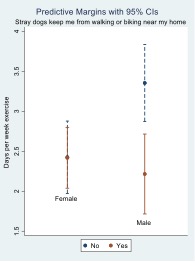
al., 2007; Ndirangu et al., 2007; Whitfield et al., 2018; Wilcox et al., 2000). Using a rural probability sample, we find that
rural men who view stray dogs as a barrier to neighborhood-based walking and
biking, on average, accrued more than one day less physical activity per
week than men without concerns about dogs. For women, there was no difference
in reported days per week physical activity between those who viewed dogs as a
barrier to neighborhood-based physical activity and those who did not. Previous
work has not examined gender as a moderator or has used samples that included
only women (Strong et al.,
2013; Wilbur
et al., 2003).
Although
we did not directly measure the reasons for the gender difference in the
effects of stray dogs on physical activity, previous research provides
potential explanations. Women in rural areas may prefer walking in groups, thus
lessening the threat of neighborhood stray dogs (Cadmus-Bertram et
al., 2020; Evans, 2011). Other barriers may impact women’s physical
activity choices more directly, such as household responsibilities, societal
expectations, and weather, making concerns about neighborhood dogs a less salient
factor in whether a woman engages in physical activity (Evans,
2011; Gilbert et al., 2019; Perry et al., 2008; Thompson et al., 2002). Additionally, many women prefer indoor physical
activity, which may make concerns about neighborhood dogs irrelevant for
physical activity behaviors (van Uffelen et
al., 2017). Although limited research exists, it could be
that compared to rural women, rural men may be more likely to exercise alone in
a neighborhood setting, and thus more impacted by concerns about stray dogs
near their home.
Other
covariates are noteworthy in the model. Food insecurity is associated with more
days per week physical activity, with participants receiving food assistance
programs or participating in the charitable food system reporting an average of
.86 more days per week of physical activity than residents who were not food
insecure. This could be because our measure for physical activity included all
physical activity, such as active transportation and occupational-based
physical activity, not just leisure activities. Unsurprisingly, better
self-rated health is associated with more days per week of physical activity. Notably,
identifying as Black was the strongest predictor in the model. Controlling for
the effects of all other variables in the model, participants who identify as
Black accrue fewer days per week of physical activity than participants who
identified as other races. This could be because the barriers to exercise in
rural communities are compounded with other barriers to physical activity faced
by Black residents. Most rural residents report a built environment
unsupportive of physical activity; Black residents may also feel unsafe to
exercise in certain places, such as rural trails furthering limited access (Whitfield et al.,
2019; Davis, 2019). For rural Black men with concerns about loose dogs in their
neighborhood, options for physical activity are further constrained.
In
rural communities where loose dogs cause concerns, community coalitions working
with partners such as Cooperative Extension, churches, libraries, and rural
health clinics may be an avenue to garner broad community support for policy
change (Holston et al.,
2020; Stroope et al., 2024). Community coalitions
can promote awareness and foster positive engagement between law enforcement
and community members to effectively change behavioral norms around dog
ownership behaviors (Joseph et al.,
2015). Collective action to make funds available for
low-cost fencing options and community-builds of electric and physical fences
may be needed to make safe containment of pets accessible for all community members
and could function as a modern-day barn-raising effort. Mobile spay/neuter
clinics could help minimize stray animals, as well as reduce aggressive
behavior towards strangers (Farhoody et al.,
2018). Local communications campaigns through local
papers, radio, church bulletins, and community board flyers could help share
local stories to build support for why containing animals is important for
their town, featuring older adults, children, and other community members
likely to be seen as needing protection to encourage containing loose animals
as a form of civic responsibility and care for others.
This
study has several limitations. The RELFA survey used the phrase “stray dogs.” However,
“loose dogs” would have been more inclusive and perhaps a more accurate measure
of threat. The survey item was tested and reviewed by residents of each
community in which the survey was fielded; it could be that the phrases are
viewed as interchangeable, or similar enough to not have raised concerns during
pilot testing (Seals et al.,
2022). In future surveys, replacing “stray dogs”
with “loose dogs” is preferable. Additionally, participants may have achieved
physical activity recommendations with fewer than 3 days per week of physical
activity, as our measure was limited to days per week of at least 30 minutes of
physical activity. Furthermore, people who spend time walking and biking in
their neighborhoods are likely to have greater exposure to loose dogs than
those who do not. The presence of loose dogs may function as a latent barrier
for those not yet engaging in outdoor physical activity. Future work should
explore how to galvanize community support in low resource rural communities to
effectively reduce the presence of loose dogs.
Although
these findings are representative of Lake Providence and St. Joseph, Louisiana,
caution should be used in interpreting the results more broadly, especially
outside of the Mississippi Delta region of the rural South. More work is needed
to understand the dynamics between gender, loose dogs, and physical activity,
especially in places with other rural demographic dynamics, such as areas with
high Hispanic or Native American populations.
However,
this study makes a unique contribution through its community-based probability
sample, placement of gender as a moderator, and robust controls. Additionally,
this study provides insight to physical activity behaviors in the rural Delta South,
an understudied area with high health disparities (Gennuso, 2016). Understanding the role of loose dogs in suppressing
physical activity among rural men provides actionable steps to reducing health
disparities in rural communities.
Correspondence
should be addressed to
Jessica
Stroope, PhD, MPH
School
of Kinesiology, Louisiana State University
2201
Huey P. Long Field House
Baton
Rouge, LA 70803
225-578-7378
jstroope@lsu.edu
 Jessica
Stroope: 0000-0002-8582-1187
Jessica
Stroope: 0000-0002-8582-1187
Laura
E. Balis: 0000-0002-8981-1621
Alex C. Garn: 0000-0002-7824-4027
Katherine Seals: 0000-0002-9799-8801
Denise Holston: 0000-0002-2426-089X
Author
contributions
Conceptualization,
J.S., Methodology, J.S. & K.S., Analysis, J.S., Writing—Original Draft,
J.S. L.E.B., A.C.G., K.S., and D.H., Writing—Review & Editing, J.S.,
A.C.G., L.E.B., D.H., K.S., Funding Acquisition, D.H, Supervision, D.H. and
A.C.G.
Acknowledgements
The author would like to thank the LSU AgCenter, Jamila
Freightman, Joy K. Sims, Matthew Greene, Maria Gonzales, Marquetta Anderson,
the community data collectors, as well as all RELFA participants for their
contributions to this study.
Conflict of Interest
Statement
The authors declare no conflicts
of interest related to the research, authorship, and/or publication of this
article.
Financial Disclosure
This publication was supported
by cooperative agreement number 58DP006570 funded by the Centers for Disease
Control.
Creative Commons
License
This work is licensed
under a Creative
Commons Attribution-Noncommercial 4.0 International License (CC BY-NC 4.0).
References
Abildso,
C. G., Daily, S. M., Meyer, M. R. U., Edwards, M. B., Jacobs, L., McClendon,
M., Perry, C. K., & Roemmich, J. N. (2021). Environmental Factors
Associated with Physical Activity in Rural U.S. Counties. International
Journal of Environmental Research and Public Health, 18(14), Article
14. https://doi.org/10.3390/ijerph18147688
Aljabri, D. (2022). Associations Between
Obesity, Physical Inactivity, Healthcare Capacity, and the Built Environment:
Geographic Information System Analysis. Journal of Multidisciplinary
Healthcare, 15, 689–704. https://doi.org/10.2147/JMDH.S345458
Bauman, A. E., & Richards, J. A.
(2022). Understanding of the Single-Item Physical Activity Question for
Population Surveillance. Journal of Physical Activity and Health, 19(10),
681–686. https://doi.org/10.1123/jpah.2022-0369
Boersma, P., Black, L. I., & Ward, B.
W. (2020). Prevalence of Multiple Chronic Conditions Among US Adults, 2018. Preventing
Chronic Disease, 17, E106. https://doi.org/10.5888/pcd17.200130
Bopp, M., Lattimore, D., Wilcox, S.,
Laken, M., McClorin, L., Swinton, R., Gethers, O., & Bryant, D. (2007).
Understanding physical activity participation in members of an African American
church: A qualitative study. Health Education Research, 22(6),
815–826. https://doi.org/10.1093/her/cyl149
Cadmus-Bertram, L. A., Gorzelitz, J. S.,
Dorn, D. C., & Malecki, K. M. C. (2020). Understanding the physical
activity needs and interests of inactive and active rural women: A
cross-sectional study of barriers, opportunities, and intervention preferences.
Journal of Behavioral Medicine, 43(4), 638–647.
https://doi.org/10.1007/s10865-019-00070-z
Callaghan, T., Ferdinand, A. O.,
Akinlotan, M. A., Towne Jr., S. D., & Bolin, J. (2020). The Changing
Landscape of Diabetes Mortality in the United States Across Region and
Rurality, 1999-2016. The Journal of Rural Health, 36(3), 410–415.
https://doi.org/10.1111/jrh.12354
Chrisman, M., Nothwehr, F., Yang, G.,
& Oleson, J. (2015). Environmental Influences on Physical Activity in Rural
Midwestern Adults: A Qualitative Approach. Health Promotion Practice, 16(1),
142–148. https://doi.org/10.1177/1524839914524958
Davis, J. (2019). Black faces, black
spaces: Rethinking African American underrepresentation in wildland spaces and
outdoor recreation. Environment and Planning E: Nature and Space, 2(1),
89–109. https://doi.org/10.1177/2514848618817480
DeGuzman, P. B., Chu, C., &
Keim-Malpass, J. (2019). Built and Natural Environment Barriers and
Facilitators to Physical Activity in Rural, Suburban, and Small Urban
Neighborhoods. Oncology Nursing Forum, 46(5), 545–555.
https://doi.org/10.1188/19.ONF.545-555
Dugani, S. B., Mielke, M. M., & Vella,
A. (2021). Burden and management of type 2 diabetes in rural United States. Diabetes/Metabolism
Research and Reviews, 37(5), e3410.
https://doi.org/10.1002/dmrr.3410
Evans, L. K. (2011). Rural Black women’s
thoughts about exercise. Applied Nursing Research: ANR, 24(4),
200–206. https://doi.org/10.1016/j.apnr.2009.09.005
Farhoody, P., Mallawaarachchi, I.,
Tarwater, P. M., Serpell, J. A., Duffy, D. L., & Zink, C. (2018).
Aggression toward Familiar People, Strangers, and Conspecifics in
Gonadectomized and Intact Dogs. Frontiers in Veterinary Science, 5.
https://www.frontiersin.org/articles/10.3389/fvets.2018.00018
Fritz, M. S., & Arthur, A. M. (2017).
Moderator Variables. In Oxford Research Encyclopedia of Psychology.
https://doi.org/10.1093/acrefore/9780190236557.013.86
Gennuso, K. P. (2016). Assessment of
Factors Contributing to Health Outcomes in the Eight States of the Mississippi
Delta Region. Preventing Chronic Disease, 13.
https://doi.org/10.5888/pcd13.150440
Gilbert, A. S., Duncan, D. D., Beck, A.
M., Eyler, A. A., & Brownson, R. C. (2019, June 23). A Qualitative Study
Identifying Barriers and Facilitators of Physical Activity in Rural Communities
[Research Article]. Journal of Environmental and Public Health; Hindawi.
https://doi.org/10.1155/2019/7298692
Hansen, A. Y., Umstattd Meyer, M. R.,
Lenardson, J. D., & Hartley, D. (2015). Built Environments and Active
Living in Rural and Remote Areas: A Review of the Literature. Current
Obesity Reports, 4(4), 484–493.
https://doi.org/10.1007/s13679-015-0180-9
Holston, D., Stroope, J., Cater, M.,
Kendall, M., & Broyles, S. T. (2020). Implementing Policy, Systems, and
Environmental Change Through Community Coalitions and Extension Partnerships to
Address Obesity in Rural Louisiana. Preventing Chronic Disease, 17.
https://doi.org/10.5888/pcd17.190284
Hughes, J., & Macdonald, D. W. (2013).
A review of the interactions between free-roaming domestic dogs and wildlife. Biological
Conservation, 157, 341–351.
https://doi.org/10.1016/j.biocon.2012.07.005
Jilcott Pitts, S. B., Keyserling, T. C.,
Johnston, L. F., Smith, T. W., McGuirt, J. T., Evenson, K. R., Rafferty, A. P.,
Gizlice, Z., Garcia, B. A., & Ammerman, A. S. (2015). Associations between
neighborhood-level factors related to a healthful lifestyle and dietary intake,
physical activity, and support for obesity prevention polices among rural
adults. Journal of Community Health, 40(2), 276–284.
https://doi.org/10.1007/s10900-014-9927-6
Joseph, R. P., Ainsworth, B. E., Keller,
C., & Dodgson, J. E. (2015). Barriers to Physical Activity Among African
American Women: An Integrative Review of the Literature. Women & Health,
55(6), 679–699. https://doi.org/10.1080/03630242.2015.1039184
King, A. C., Castro, C., Wilcox, S.,
Eyler, A. A., Sallis, J. F., & Brownson, R. C. (2000). Personal and
environmental factors associated with physical inactivity among different
racial-ethnic groups of U.S. middle-aged and older-aged women. Health
Psychology: Official Journal of the Division of Health Psychology, American
Psychological Association, 19(4), 354–364.
https://doi.org/10.1037//0278-6133.19.4.354
LaVallee, E., Mueller, M. K., &
McCobb, E. (2017). A Systematic Review of the Literature Addressing Veterinary
Care for Underserved Communities. Journal of Applied Animal Welfare Science,
20(4), 381–394. https://doi.org/10.1080/10888705.2017.1337515
Ndirangu, M., Perkins, H., Yadrick, K.,
West, J. R., Bogle, M. L., Avis-Williams, A., Santell, R., & Connell, C. L.
(2007). Conducting needs assessment using the comprehensive participatory
planning and evaluation model to develop nutrition and physical activity
interventions in a rural community in the Mississippi delta. Progress in
Community Health Partnerships: Research, Education, and Action, 1(1),
41–48. https://doi.org/10.1353/cpr.0.0005
Payne, B. K., Berg, B. L., & Sun, I.
Y. (2005). Policing in small town America: Dogs, drunks, disorder, and
dysfunction. Journal of Criminal Justice, 33(1), 31–41.
https://doi.org/10.1016/j.jcrimjus.2004.10.006
Perry, C. K., Rosenfeld, A. G., &
Kendall, J. (2008). Rural Women Walking for Health: Western Journal of
Nursing Research. https://doi.org/10.1177/0193945907303036
Sallis, J. F., Cervero, R. B., Ascher, W.,
Henderson, K. A., Kraft, M. K., & Kerr, J. (2006). An ecological approach
to creating active living communities. Annual Review of Public Health, 27,
297–322. https://doi.org/10.1146/annurev.publhealth.27.021405.102100
Sanderson, B., Littleton, M., &
Pulley, L. V. (2002). Environmental, Policy, and Cultural Factors Related to
Physical Activity Among Rural, African American Women. Women & Health,
36(2), 73–88. https://doi.org/10.1300/J013v36n02_06
Seals, K., Stroope, J., Freightman, J.,
Ainsworth, L., Moles, A., & Holston, D. (2022). Empty Houses, Loose Dogs,
and Engaged Citizens: Lessons Learned From Community Participatory Data
Collection in Rural Areas. Health Promotion Practice, 23(1_suppl),
140S-148S. https://doi.org/10.1177/15248399221111181
Singh, G. K., Daus, G. P., Allender, M.,
Ramey, C. T., Martin, E. K., Perry, C., Reyes, A. A. D. L., & Vedamuthu, I.
P. (2017). Social Determinants of Health in the United States: Addressing Major
Health Inequality Trends for the Nation, 1935-2016. International Journal of
MCH and AIDS, 6(2), 139–164. https://doi.org/10.21106/ijma.236
Strong, L. L., Reitzel, L. R., Wetter, D.
W., & McNeill, L. H. (2013). Associations of perceived neighborhood
physical and social environments with physical activity and television viewing
in African-American men and women. American Journal of Health Promotion:
AJHP, 27(6), 401–409. https://doi.org/10.4278/ajhp.120306-QUAN-127
Stroope, J., Umstattd Meyer, M. R.,
Gabbert, K., John, D. H., Kellstedt, D., Orzech, K. M., & Wende, M. E.
(2024). Physical Activity Policy, Systems, and Environment Change Through
Extension SNAP-Ed: A Multistate Perspective. Health Promotion Practice,
15248399231221779. https://doi.org/10.1177/15248399231221779
Thompson, J. L., Allen, P.,
Cunningham-Sabo, L., Yazzie, D. A., Curtis, M., & Davis, S. M. (2002).
Environmental, policy, and cultural factors related to physical activity in
sedentary American Indian women. Women & Health, 36(2),
59–74. https://doi.org/10.1300/j013v36n02_05
Umstattd Meyer, M. R., Moore, J. B.,
Abildso, C., Edwards, M. B., Gamble, A., & Baskin, M. L. (2016). Rural
Active Living: A Call to Action. Journal of Public Health Management and
Practice: JPHMP, 22(5), E11-20.
https://doi.org/10.1097/PHH.0000000000000333
van Uffelen, J. G. Z., Khan, A., &
Burton, N. W. (2017). Gender differences in physical activity
motivators and context preferences: A population-based study in people in their
sixties. BMC Public Health, 17(1), 624.
https://doi.org/10.1186/s12889-017-4540-0
Whitfield, G. P. (2019). Trends in Meeting
Physical Activity Guidelines Among Urban and Rural Dwelling Adults—United
States, 2008–2017. MMWR. Morbidity and Mortality Weekly Report, 68.
https://doi.org/10.15585/mmwr.mm6823a1
Whitfield, G. P., Carlson, S. A., Ussery,
E. N., Watson, K. B., Berrigan, D., & Fulton, J. E. (2019). National-level
environmental perceptions and walking among urban and rural residents:
Informing surveillance of walkability. Preventive Medicine, 123,
101–108. https://doi.org/10.1016/j.ypmed.2019.03.019
Whitfield, G. P., Carlson, S. A., Ussery,
E. N., Watson, K. B., Brown, D. R., Berrigan, D., & Fulton, J. E. (2018).
Racial and ethnic differences in perceived safety barriers to walking, United
States National Health Interview Survey – 2015. Preventive Medicine, 114,
57–63. https://doi.org/10.1016/j.ypmed.2018.06.003
Wilbur, J., Chandler, P. J., Dancy, B.,
& Lee, H. (2003). Correlates of physical activity in urban Midwestern
African-American women. American Journal of Preventive Medicine, 25(3,
Supplement 1), 45–52. https://doi.org/10.1016/S0749-3797(03)00164-8
Wilcox, S., Castro, C., King, A. C.,
Housemann, R., & Brownson, R. C. (2000). Determinants of leisure time
physical activity in rural compared with urban older and ethnically diverse
women in the United States. Journal of Epidemiology & Community Health,
54(9), 667–672. https://doi.org/10.1136/jech.54.9.667
Wilcox, S., Oberrecht, L., Bopp, M.,
Kammermann, S. K., & McElmurray, C. T. (2005). A Qualitative Study of
Exercise in Older African American and White Women in Rural South Carolina:
Perceptions, Barriers, and Motivations. Journal of Women & Aging, 17(1–2),
37–53. https://doi.org/10.1300/J074v17n01_04
Supplementary Materials
Supplemental Table 1. Unadjusted OLS regression results: Days per week
of at least 30 minutes physical activity, predicted in 3 unadjusted models
|
|
b
|
SE
|
P-value
|
95% CI
|
|
Male
|
0.54
|
0.23
|
0.018
|
0.10
|
0.99
|
|
intercept
|
2.49
|
0.14
|
0.000
|
2.21
|
2.78
|
|
n=459
|
|
|
|
|
|
|
Stray dogs
|
- .29
|
0.23
|
0.210
|
-0.74
|
0.16
|
|
intercept
|
2.83
|
0.17
|
0.000
|
2.50
|
3.17
|
|
n=441
|
|
|
|
|
|
|
Male
|
1.33
|
0.34
|
0.000
|
0.66
|
1.99
|
|
Stray Dogs
|
0.32
|
0.30
|
0.282
|
-0.26
|
0.91
|
|
Male * Stray dogs
|
-1.39
|
0.46
|
0.003
|
-2.30
|
-0.48
|
|
intercept
|
2.21
|
0.23
|
0.000
|
1.76
|
2.65
|
|
n = 437
|
|
|
|
|
|
RELFA, 2020-2021. List-wise deletion. Lake Providence & St. Joseph,
Louisiana. Source: Author
Supplemental Table 2. Multiple Imputation estimates, OLS Regression.
Days per week of at least 30 minutes physical activity
|
|
b
|
SE
|
P-Value
|
95% CI
|
|
Male
|
0.94
|
0.34
|
0.006
|
0.27
|
1.60
|
|
Black
|
-1.47
|
0.30
|
0.000
|
-2.06
|
-0.89
|
|
Education
|
0.02
|
0.06
|
0.757
|
-0.11
|
0.15
|
|
Age
|
-0.01
|
0.01
|
0.398
|
-0.02
|
0.01
|
|
Self-rated health
|
0.49
|
0.12
|
0.000
|
0.25
|
0.72
|
|
Food insecurity
|
0.70
|
0.26
|
0.008
|
0.18
|
1.23
|
|
Stray dogs
|
0.13
|
0.30
|
0.661
|
-0.46
|
0.73
|
|
Stray dogs*male
|
-0.95
|
0.46
|
0.039
|
-1.85
|
-0.05
|
|
Intercept
|
2.65
|
0.67
|
0.000
|
1.33
|
3.96
|
RELFA, 2020-2021. n = 491, multiple imputation estimates (20
imputations). Lake
Providence & St. Joseph, Louisiana.