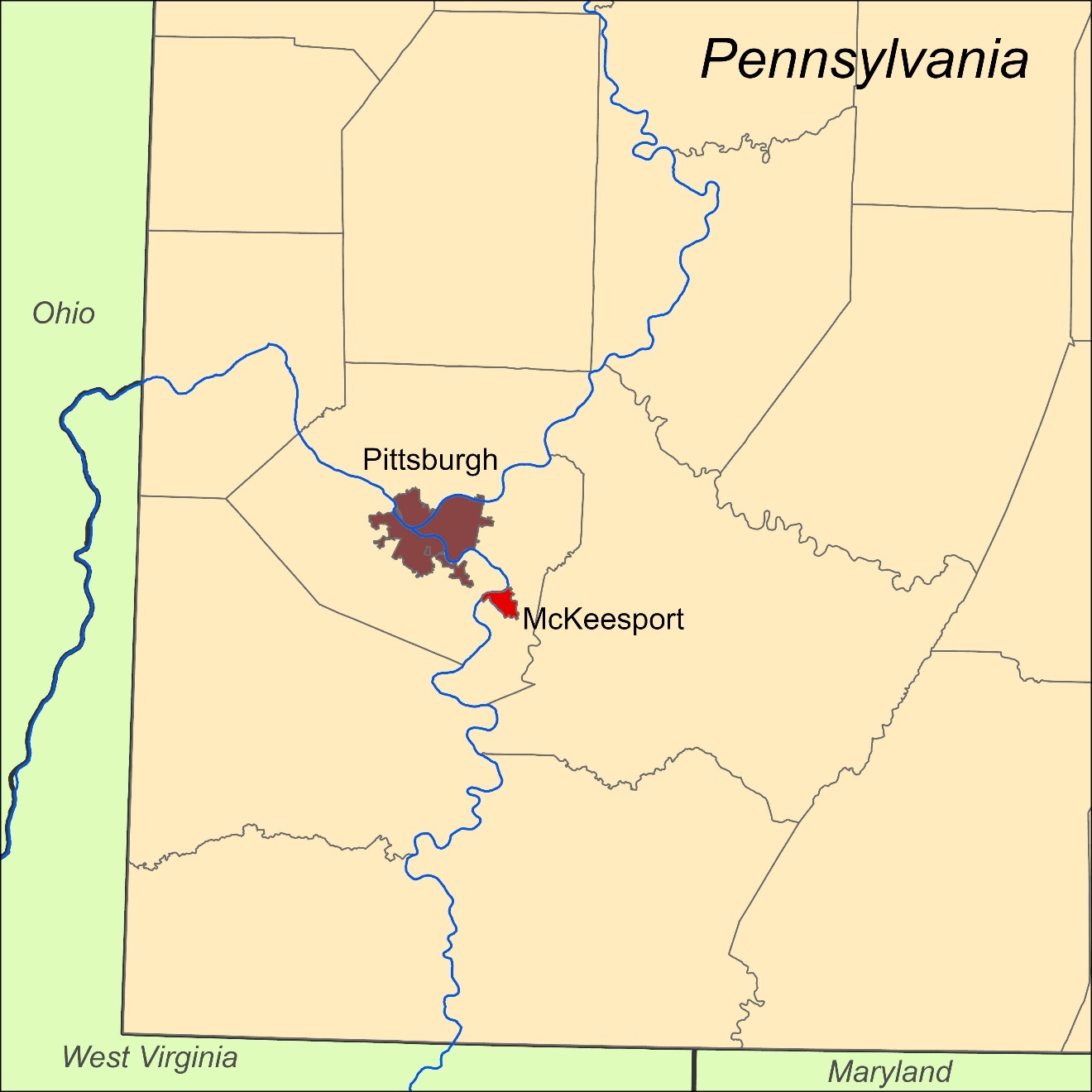
Figure 1: Map of Study Area
Rust and Ruin: How Deindustrialization’s Ghosts Shape Urban Health and Landscapes
Hannah E. Hardy1 and Sabina Deitrick2
1Allegheny County Department of Human Services Office of Aging Services,
Pittsburgh, PA, U.S.A.
2University
of Pittsburgh, School of Public and International Affairs, U.S.A.
Abstract
The closure of steel mills along the Monongahela River in the late 20th century dramatically reshaped communities in Allegheny County, Pennsylvania. This case study examines the enduring impacts of deindustrialization on McKeesport, Pennsylvania, one of those river towns and once at the epicenter of the Pittsburgh region's industrial revolution. McKeesport, like many former industrial hubs, has long grappled with the impacts of deindustrialization, including population loss, economic decline, and striking health disparities. The physical landscape bears witness to this transformation, with high rates of blight, vacant land, and abandoned properties. Through the lens of neoliberal capitalism, this research explores how deindustrialization fundamentally altered the community’s fabric and health outcomes. The question guiding this research is how do the long-term outcomes of deindustrialization impacting the built environment contribute to health experiences of the people who live in McKeesport, PA? The study identifies strategies for mitigating these impacts of deindustrialization, particularly by addressing the legacy that vacant land and abandoned property have on health policy implications. Ultimately, this project contributes to the broader discourse on reducing health disparities in deindustrialized communities, offering insights that may inform policy and revitalization efforts in similar post-industrial landscapes across the United States considering persistent neoliberal trends.
Keywords: deindustrialization, public health, built environment, vacant land.
Allegheny County in southwestern Pennsylvania was once one of the most industrialized regions in the world, and much of its industrial activity was tied to the Monongahela River. For 130 years, from 1853 to 1983, there were ten large steel mills along a 23-mile segment of that river, running upriver from Pittsburgh to Clairton (Toker, 1986). Life in these towns was characterized by bustling business districts and homes filled with young families, many of whom were new to the United States. McKeesport was one such community, a center for steelmaking in the country. Beginning in the 1980s, as steelmaking declined in the Mon Valley and McKeesport’s mill closed, McKeesport declined on multiple scales. Over the past four decades, the community has not seen a revitalized local economy and has continued a cycle of economic decline. Neoliberal policies that impacted the transfer of capital in deindustrialized communities resulted in a spatial restructuring in communities like McKeesport, with impacts that persist today (Smith, 2008, p. 1).
This research examines the impacts of deindustrialization on residents and their health outcomes in McKeesport, Pennsylvania. McKeesport opens a window to understand the links between community distress and health outcomes over forty years of economic decline. How do the built environment outcomes of 20th century deindustrialization contribute to health experiences of the people who live in McKeesport today? Using a case study approach, the authors seek to identify what can be done to mediate the legacy impacts of deindustrialization by addressing the long-term effects vacant land and abandoned property have had on the built environment and residents’ health. Quantitative data provides compelling evidence of the impacts on chronic conditions, mental health & substance abuse, public safety, and environmental health that contradict the recovery of the physical place that is often told. This research provides new insights by connecting an exploration of the social determinants of health (SDOH) and health disparities to the story of deindustrialization and by making a clear connection between deindustrialization, public health, and place. By connecting the socio-political process of deindustrialization to public health, vacant land and abandoned property, this research contributes to the literature used by public health and community development professionals who are working in deindustrialized communities in a way that will impact policy and program development. The results of this study suggest that adoption of a public health approach that accounts for the social determinants of health and place-based community development are necessary for deindustrialized communities that have yet to revitalize.
Study Area
Located at the confluence of the Monongahela and Youghiogheny Rivers, McKeesport was one of the earliest settlements in the area and began its rapid growth in the middle of the 1800s with its first steel mill, the National Tube Company (see Figure 1). This made McKeesport the nation’s leading producer of steel pipe and that role continued with the formation of US Steel in 1901. McKeesport grew over the next century, and by 1940, McKeesport had 55,355 residents, many working in the steel industry. The city’s prosperity did not last. Its rapid decline began in the 1980s, when steel production in the Mon Valley, hard hit by foreign competition, deregulation, declining demand, disinvestment, and continued labor issues, collapsed across the Pittsburgh region. One of the most remarkable things about the decline of the steel industry in McKeesport and the Pittsburgh region is the level of devastation that took place in such a short period of time.
Figure 1: Map of Study Area
The legacy impacts of deindustrialization can be seen in a number of indicators in McKeesport. McKeesport over decades became a ‘left-behind’ community, with many residents moving out and lower income residents left behind (Bohnel, 2025; Deitrick, 1999). The population of McKeesport declined steadily over decades from its peak of over 55,000 residents in the middle of the 20th century. By 2000, the population dropped by well over half to 24,045, with 72.4 percent white residents and 24.5 percent Black residents. Over the next two decades, the total population dropped again to 17,520 in 2023, with the number of white residents falling by over 50 percent, while Black residents increased by nearly 15 percent (U.S. Census Bureau, 2023).
Coupled with population decline has been an increase in poverty rates in the community. McKeesport and neighboring communities in the Mon Valley remain among the poorest in the Pittsburgh region today with over 40 percent of people eligible for health care assistance and nearly 40 percent of households eligible for food assistance through the Supplemental Nutrition Assistance Program in 2025 (Bohnel, 2025). These are much higher than the Allegheny County averages of 18.6 percent and 13.1 percent in 2025 respectively. In McKeesport, 32.9 percent of residents lived below the poverty line in 2023, compared to an 11.2 percent poverty rate for all of Allegheny County (Allegheny County Health Department, 2025). These changes in McKeesport lead us to understanding the legacy impacts of deindustrialization through health, neoliberal policies, and the built environment.
Methods and Data
To answer the research question, the authors developed a conceptual framework that draws on theory and research from geography and public health. The research design uses thematic inquiry methodology to understand this case and a mixed methods approach, consisting of stakeholder interviews, primary documents review, and secondary data analysis (Denzin & Giardina, 2009). Qualitative and quantitative data were collected and analyzed concurrently (Creswell & Cresswell, 2018, p. 217). This project was acknowledged by the Point Park University Institutional Review Board (IRB approval #06042021).
Conceptual Framework
The conceptual framework provides a structure for data analysis as the concepts that are included were used for coding and developing the themes (see Figure 2). At the center is people’s connection to place and how socio-economic decline affects residents and their health outcomes. Understanding one set of spatial outcomes from deindustrialization, neoliberal policies, and uneven development shows how vacant land and abandoned property were created and became legacy impacts on McKeesport residents. The analysis employs a public health framework to analyze the impacts of the built environment on residents’ health. In McKeesport, that resulted in long-term uneven health outcomes and health inequities. These concepts are intertwined and causal, and the conceptual framework provides the opportunity to analyze the interactions of power, geospatial relations, and economic production on people living in deindustrialized communities in Allegheny County and then to generalize to other similar cases.
Figure 2: Conceptual Framework
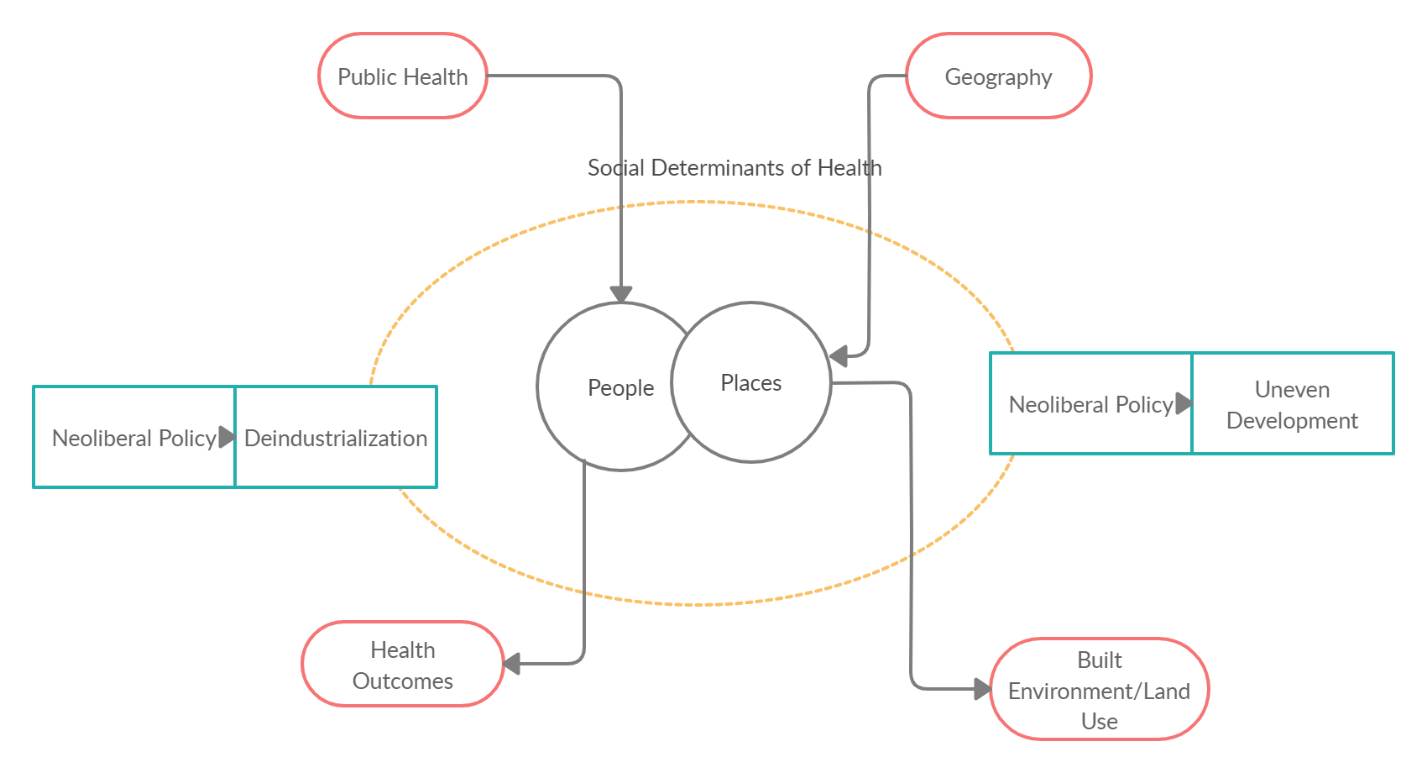
The following is a brief discussion of the main constructs of the conceptual framework.
Social Determinants of Health (SDOH) are the social and environmental factors that impact a person’s physical health that are outside the traditional healthcare system or doctor’s office. These include economic stability, educational background, community context, access to social services and support structure, neighborhood and built environment, and access to health and healthcare (Robert Wood Johnson Foundation, 2010). Applying SDOH as a framework balances the impacts of a person’s behavior and biology with the social and environmental context in which they live and work when considering health outcomes (Ansari, et al., 2003, p. 242).
The stark reality of deindustrialized communities is in the social gradient of health and disease (Marmot, 2003, p. S10). McKeesport shows worse health outcomes than Allegheny County on average on a number of indicators. Life expectancy in McKeesport ranges from 69.1 years to 73 years, depending on neighborhood, compared to 76.9 years for Allegheny County and 77.5 years for Pennsylvania in 2025. In McKeesport, 17.7 percent of adults had diabetes in 2022, compared to 11 percent in Allegheny County (Allegheny County Health Department, 2025).
Neoliberalism in practice and policy played a significant role in deindustrialization. The U.S. and Pennsylvania lacked significant plant closing legislation and effective retraining policies, and plant closures left high rates of vacancy, property abandonment, and job loss in older industrial communities, such as McKeesport. One neoliberal response to plant closings is outmigration. The Pittsburgh region’s unemployment rate reached 18.2 percent in 1983 and fell to 8.8 percent by 1986. The loss of over 115,500 jobs in that period was compensated largely through outmigration of younger, unemployed workers and augmentation of its economy to “meds and eds” (Deitrick, 1999).
For most of its history, McKeesport was built on its steel mill and manufacturing plants, alive with community activity and commerce that supported residents. It boasted an active business district and business sector, community events, strong religious and ethnic communities, and a school district that prepared youth for employment. “From fine dining, to specialty shops, to department stores, to five and dimes, grocers, greasy spoons, banks, and bars, and pool halls – downtown McKeesport catered to the middle class and wealthy as a leading edge commerce center” (Casey, 2025). The community was dependent on US Steel. When US Steel was producing, so was the community; when it stopped, so did large parts of community activity. Coupled with this were austerity policies of government agencies that cut public spending and social services. Lack of effective policy outcomes worsened public health in many ways by shrinking or privatizing public service, or both, and dismantling welfare programs at a time of increased need and demand (Brenner & Theodore, 2002, p. 350; Cummins, 2018). That is the legacy playing out in McKeesport today.
Deindustrialization represents many transitions over time within advanced capitalism, resulting in the shuttering of industrial plants and permanent loss of tens of thousands of jobs in industrial regions (Cowie & Heathcott, 2003, p. 3; Kim; Strangleman, Rhodes & Linkon, 2013, p. 10). In Allegheny County, the Mon Valley communities did not rebound or revitalize following the closure of plants and steel mills in the 1980s (Deitrick, 1999). Deindustrialization created a landscape that deeply impacted the residents of these communities, now decades long. Much research has covered the rise and the fall of the steel industry in Allegheny County (Bluestone & Harrison, 1982; Cowie & Heathcott, 2003; Deitrick, 2015; Dieterich-Ward, 2016; Glaeser, 2011; Hathaway, 1993; Hinshaw, 2002; Hoerr, 1988; Toker, 1986; Vitale, 2015; Winant, 2019). In addition to these works, High (2013) explored 40 years of scholarship on deindustrialization and concluded that despite the critical focus on impacts of economic restructuring, deindustrialization can also be analyzed as a cultural and social process (High, 2013; High & Lewis, 2007). With that understanding, we know that deindustrialization has had significant health, as well as social consequences, and the implications for health are part of the contextualization of deindustrialized places (Mackenzie, et al., 2017; Winant, 2019; Walsh, et al., 2017).
Another manifestation of deindustrialization is uneven development (Harvey, 2005; Brenner & Theodore, 2002, 2010). Uneven development is the physical manifestation of a transfer or shift of power, capital, or influence from one physical place to another. In the literature surrounding urban geography, there are several analyses of uneven development based on class, race, and social status (Brenner & Theodore, 2002; Harvey, 2006; Massey, 1995; Massey & Denton, 1993; Smith, 2008; Vitale, 2015; Walks, 2009). There is a direct implication of uneven development to the discussion of health inequality in deindustrialized communities because the “opportunities, resources, and benefits are not evenly distributed across the urban landscape” (Massey & Denton, 1993, p. 149).
When we compare McKeesport with other places in Allegheny County, we can clearly see the patterns of uneven development, with disinvestment in McKeesport occurring over decades in multiple areas:
· Economic: Devalued properties produce lower revenue and are more expensive to maintain (Bonham, 2002, p. 9; Carlet, Schilling, & Heckert, 2017, p. 889; Delta Development Group, 2013, p. 9). Total estimated delinquent taxes owed to McKeesport in 2010 were $350,916 (Delta Development Group, p. 7).
· Safety: Violence and safety concerns grow in and around abandoned property (Branas et al., 2018; Carlet et al., 2017, p. 889). In 2010, 26.1 percent of the housing units in McKeesport were vacant, and only 34.8 percent of units were occupied by the owner (Delta Development Group, p. 7).
· Health: Decline in residents’ physical and mental health, including higher stress and shortened life expectancy (Garvin, et al., 2013; Pagano & Bowman, 2000; South, 2021). McKeesport life expectancy is well below county, state and federal averages (Maseru, 2021).
The cumulative process of uneven development continues with vacancies, abandonment, and poor health outcomes persisting over 40 years. The cumulative effects of decline results in continued growth of vacant land and abandoned buildings.
Twelve individual, semi-structured interviews were conducted from July 7, 2021-September 9, 2021. Participants were identified by a process of purposeful sampling that led to snowball or opportunistic sampling. Interviewees included long-time McKeesport residents, current and former members of McKeesport City Council, McKeesport city officials, leaders of non-profit organizations, and a member of Allegheny County Council. Participants include: 4 men, 8 women; 7 white respondents, 5 Black respondents; 3 local leaders, 1 resident expert, 3 non-local experts, and 5 local leaders who were also residents.
Due to COVID-19 protocols, 10 of the interviews were held via video conference. Two interviews were held in person at the request of the interview subject. Refer to Appendix A for the interview protocol. Interviews were recorded and then transcribed. The transcriptions were uploaded to Nvivo Version 13 for coding and analysis.
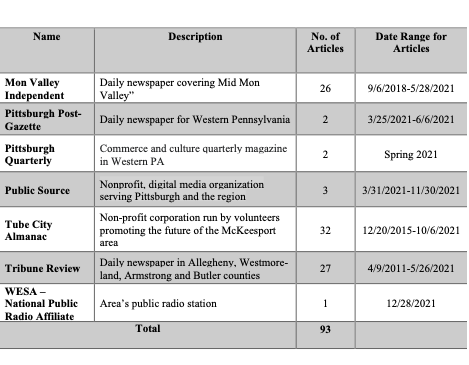
We also collected 93 articles that appeared in eight different local news media sources, published between April 9, 2011-December 28, 2021 (see Table 1). This period was selected to capture the current impacts over a ten-year period that ended when the research concluded. Local news outlets that cover McKeesport were selected to be included. All articles during this period with relevant content were included for analysis. Each article was uploaded to Nvivo Version 13 for data analysis. We created one project in Nvivo for data analysis and within that project distinguished between interview data and document data so that the information was coded in the same project.
Table 1: Description of Document Data Sources
Secondary Data Analysis
This research drew from the publicly available data about health outcomes and the location of vacant land and abandoned property to understand the impacts of geography on people in McKeesport. The authors relied on the methods of spatial epidemiology using geographic correlation and identifying clusters of disease evident in publicly available Geographic Information Systems (GIS) maps that helped to understand how geography impacts health (Elliott & Wartenberg, 2004). The research combined data from U.S. Census Bureau, Centers for Disease Control (CDC), and Allegheny County Health Department (ACHD) to collect information about health outcomes and the physical environment, including land uses. These data are used to complement the interview and document data and validate information collected in interviews and documents. Sources of secondary data include:
· Community health indicators (Allegheny County Health Department, 2025).
· National disease rates (Centers for Disease Control, 2025).
· Building conditions data (University of Pittsburgh, 2025).
The authors used both theory-driven and data-driven codes as part of the analysis process. We started data analysis with inductive coding by listening to the data to see what codes emerge (Creswell & Creswell, 2018, p. 64; Miles, et al., 2020, p. 74). We employed data analysis by applying the perspective of the conceptual framwork to the data (Cresswell & Cresswell, 2018, p. 58; Miles, et al., 2020, p. 74). As part of the analysis, as with DeCuir-Gunby et al. (2011), this process enabled us to check the reliability of the theory-based codes by “reviewing and revising the codes in context” (p. 143). The research incorporated activities into the data collection and analysis phases of this study to achieve a valid and reliable study including triangulation and self-reflective memos. Triangulation was used to compare the different forms of data and to confirm the results that are coming from the research (Baxter & Jack, 2008, p. 556; Creswell & Creswell, 2018, p. 200; Stake, 1995, p. 112). Appendix B shows the main elements of the conceptual framework that were used as part of this analysis. The deductive analysis contributed to the process of organizing codes into themes, that enabled us to interpret the data.
From the data, we identified two main themes and six sub-themes (see Table 2). People and place are at the center of the conceptual framework that guides this work, and they were also central to the results of this study. Place refers to the built environment, and the sub themes are ownership, demolition and revitalization, and disinvestment. People refer to the health outcomes of people living in McKeesport and the sub themes are chronic conditions, mental health and substance use disorder and public safety.
Table 2: Categories, themes and subthemes that emerged from the data collection
|
Conceptual Framework |
Themes |
Subthemes |
|
Place |
Place and the built environment |
· Ownership · Demolition and revitalization · Disinvestment (uneven development) |
|
People |
People and health outcomes |
· Chronic Conditions · Mental Health & Substance Use Disorder (SUD) · Public Safety |
Theme 1: Place and the built environment
The first theme is focused on the built environment and McKeesport as a place with its social, cultural, physical, health, and economic characteristics. Residents are attached to this place, and it is an important part of their identity. There are also differences in how people perceive McKeesport as a place, with both negative and positive perceptions, and some contradictory. Three manifestations of the importance of place are subthemes.
· Ownership, who owns land, and how important land ownership is when addressing issues of blight in a deindustrialized community.
· Municipal policies and focus on demolition and redevelopment in response to blight in the community.
· Disinvestment and uneven development in McKeesport.
For some in the community there is a negative perception of place that can be attributed to changes that have taken place with deindustrialization, specifically high rates of vacancy and blight. This perception is shared by both people who live and work in McKeesport and outsiders. These negative perceptions are strongest in newspaper articles but were also repeated by interviewees. One interviewee stated:
And so, if you have vacant homes, abandoned homes, if you have properties that aren't being taken care of, people don't see themselves as having value (in) your community (and) don't see themselves as having value. So, you kind of get this, you know, just (a) community of despair, and how do we combat that? How can we talk about exercise when there's no place to exercise? How can we talk about healthy living when not everybody has access to fresh foods and vegetables, but that's the economics of the community? When there's a new building, it's a marijuana distribution (business). And so, what does that say to the investment of our community?
This respondent’s negative perception and efforts to overcome this perception form the core of the vicious cycle of disinvestment, which public health researchers have applied to analyzing influences affecting health outcomes of community members (O’Brien, Farrell & Welsh, 2019, p. 273). It is a perception of place from a resident, linked to years of disinvestment that induce poor health behaviors in individuals, causing individuals to reduce time spent outside and limit their physical activity, and may increase stressors because they are linked to the physical environment and perception of it. Evidence from multiple interviews suggests that residents share these same concerns. The mayor’s swift response to vacant land and abandoned property (discussed below) also suggests that the administration ascribes to the broken windows theory.
Subtheme 1: Ownership
A subtheme that plays a major factor in what municipal leaders and others can do with problematic properties in their community is ownership. Determining and gaining ownership of properties that are vacant and/or abandoned are important factors to reduce blight. In many cases, properties in McKeesport fall into disrepair and tax delinquency because the owner either lives elsewhere, has died, or no longer can take care of the property, producing a weak real estate market. In 2011, for example, the value of estimated delinquent property taxes owed to municipality was $350,916 (Delta Development Group, 2013, p. 29). Determining and gaining ownership is a major challenge that takes time and expense, an added challenge for cash strapped McKeesport. These costs are incurred before any demolition, remediation, or redevelopment costs. One interviewee summarized the process of conducting title searches to determine ownership, pay back taxes, and clear the title: “You have to do title searches ... (T)here has to be a certain amount of time. Then you have to contact them. Then you have to give them time to pay their back taxes and all of that.”
For example, in 2018, the City of McKeesport put 172 vacant houses and buildings on a demolition list, with properties described as “severely tax delinquent” (Togyer, 2018c). To proceed with the demolition, the municipality held a public hearing for every property, and, in most cases, no one showed up to contest the demolition. Most often, the property owner was deceased, often long deceased, or was an absentee owner (Togyer, 2017). With three taxing bodies, the pre-development and tax responsibilities are often years to resolve before anything can be done to the property.
Subtheme 2: Demolition and revitalization
With so much property abandonment, one of the main strategies the City of McKeesport used was demolition, a common strategy in disinvested municipalities. According to the City’s Redevelopment Director, there were roughly 1,000 buildings that needed to be demolished. He estimated that from roughly 2019-2021, the city demolished 400 structures. The current city administration’s approach of demolition was widely covered in the local news media (Stitt, 2021a; The Tube City Almanac, 2021; Togyer, 2021, 2021a, 2021b, 2018a, 2018b, 2018c, 2017; Vertullo, 2011). While demolition is costly for the city, the administration has allocated funding and applied for funding to complete their demolition plans (Stitt 2021; Togyer, 2017a, 2018, 2018a, 2018b, 2021, 2021a; The Tube City Almanac, 2021).
Community leaders, on the other hand, are concerned with the amount of demolition taking place. Some interviewees questioned whether there is too much demolition, especially without input from residents. A community member said that there is no process to get a building on the demolition list. She said that residents need to “harass the local government” to get a structure on the list, and she cited the lack of overall planning for what buildings are going to be demolished.
Another interviewee, who is the leader of a local environmental organization, was concerned about the impacts of tearing down homes built before major regulations on lead paint and asbestos and the safe disposal of those materials by contractors.
The City of McKeesport set a vision for redevelopment for the community, McKeesport Rising, with the goal to “demolish blighted properties that are deemed beyond repair, restore historic commercial properties and market them for new development” (Stitt, 2021). In addition to focusing on blight removal, McKeesport Rising set a vision for redevelopment of commercial areas to attract new businesses to the city. One project that was mentioned by two interviewees was the redevelopment of the Penn-McKee Hotel into a small hotel in the central business district. It holds a strong sense of place for longtime McKeesport residents, for it hosted a debate between two freshman congressmen in 1947, Richard Nixon and John F. Kennedy, one pro and one con on the Taft-Hartley Act and its impact on labor[1]. “[The Mayor] believes returning the long-shuttered, iconic hotel to commercial or retail use would help change the perspective of the city,” (Finch, 2019). This echoes the discussion about the perception of place in McKeesport. This redevelopment effort was a failure, and the building is slated for demolition.
There are community concerns that demolition forever changes the character of the built environment. One resident who was interviewed was nostalgic about this. On the one hand, she understood that abandoned and unsafe structures need to be taken down “when they are beyond repair,” but, on the other hand, she is upset about seeing so many homes torn down:
One of the things that the mayor has been doing is really trying to address blight and he has this thing called McKeesport Rising. But in doing that, it's taking down a lot of structures, which is really hard for me because it's just been heartbreaking to see so many beautiful old places ... let go ... I get why they're being torn down because they're kind of beyond repair and nobody would have the money to put in to fixing them up and ever get it or come here, but lot more vacant lots because they are tearing down so many structures.
Subtheme 3: Disinvestment (uneven development)
The third theme captures disinvestment in McKeesport that results in unequal development and uneven outcomes. One interviewee, who is a local expert in community development in communities with high rates of vacant land and abandoned property, talked about the uneven development that is characteristic of McKeesport and similar communities.
That's because all of what you're talking about, the process of deindustrialization, didn't happen in a vacuum, so it's not, it wasn't just here in Pittsburgh, it was a global phenomenon. However, what did happen on purpose and in a contrived way was the preparedness of certain communities to weather that type of change, and the direction of investment for a new information and services-based economy into certain communities and not others. And because here in this country, during the time of the industrialization, also the height of racial segregation and conservatism of growth of conservatism and a nationalist viewpoint, we redeveloped our communities unequally. And so, what you have said is exactly that, how that played out over space and over time is that historically discriminated and disadvantaged communities, particularly communities of color, through redlining (and) predatory lending practices ... have essentially been boxed into certain communities along with some of the most noxious land uses that a city produces in order to operate.
Continued disinvestment in towns like McKeesport contributed to legacy environmental justice issues that persist. Reclaiming ownership contributes to an understanding of uneven development in McKeesport. This was further clarified by another interviewee:
…every piece of land of this country is owned by someone, someone claims it and people aren't just out here giving it away. We’ve got to fight for it and secure it and plan for it and steward it and turn it into the intergenerational asset, that it is, and making sure that the families that haven't had access to, or have had those intergenerational assets stripped from them through racial policies have those restored. There’s justice, and we can all move forward because when those families do better, we all do better. When someone is able to support their child through college, because they own a home and can have an income property because their parents gave it to them. That's an intergenerational effect that white families in this country have had since the beginning and families of color…That's the justice part.
Disinvestment is not limited to the stark economic differences between McKeesport and other communities in Allegheny County. McKeesport is an environmental justice (EJ) area (Office of Environmental Justice, 2025), places with heightened environmental hazards and higher health risks than non-EJ areas. McKeesport is one of five municipalities in the county with the worst EJ scores. In almost every measurable impact, McKeesport residents experience the worst outcome when compared to other communities in Allegheny County. This will be discussed in greater detail in the next section as we shift to the health experiences of McKeesport residents.
Theme 2: People and health outcomes
The second theme to emerge from this research focuses on residents’ physical and mental health and the impacts of living among vacancies and abandonment. The age-adjusted death rate provides a general sense of McKeesport’s health when compared to other communities. This measure represents what mortality rates would be if all populations had the same age distribution. McKeesport has an age-adjusted death rate of 1,281.8/100,000, which is higher than the Allegheny County rate (820.4/100,000) and the United States (817.8/100,000) (Allegheny County Health Department, 2025). McKeesport fares worse than all other communities in Allegheny County and against state and national averages on virtually every scale of health outcomes.
Subtheme 1: Chronic conditions
The four main chronic conditions that contribute to preventable death worldwide are diabetes, heart disease/stroke, cancers, and respiratory diseases. Chronic disease risk behaviors, or the behaviors that contribute to chronic disease rates, are nutrition and how people eat, rates of physical activity, smoking and tobacco use, and consumption of alcohol. In virtually all the indicators selected, McKeesport fared worse than other areas in Allegheny County (see Table 3).
Table 3: Percentage of chronic conditions in the United States, Allegheny County and City of McKeesport
|
Chronic Condition |
United States |
Allegheny County |
McKeesport |
|
Adults with Diabetes |
12.0% |
11.0% |
17.7% |
|
Adults Experiencing Coronary Heart Disease |
6.8% |
7.1% |
10.5% |
|
Adults with Asthma (Current) |
9.9% |
10.5% |
12.6% |
|
Adults with COPD |
6.8% |
7.2% |
12.8% |
|
Adults Experienced a Stroke |
3.6% |
3.4% |
6.4% |
|
Adults who are Obese |
33.3% |
31.0% |
40.8% |
(Allegheny County Health Department, 2025)
Communities, such as McKeesport, have less access to grocery stores and healthy food and more access to convenience stores and highly processed foods that contribute to unhealthy conditions (Firestine & Murrell, 2024). This is not only an issue that is related to health, but also the market shifts that have taken place in McKeesport. The once thriving business district no longer exists. One of the interviewees, a medical doctor in the local hospital, echoed this from her experience treating residents. She connected the chronic condition of obesity in McKeesport to the fact that it is considered a food desert, and residents have fewer choices for healthy food.
Subtheme 2: Mental health & substance use disorder (SUD)
Both mental health issues and substance use disorders (SUD) are prevalent in McKeesport. Mental health and SUD impact a person’s overall health outcomes, including quality of life and mortality rates. In over half the cases of SUD, there is a co-occurring mental health issue, so these two will be considered together here. There are two issues that were discussed by interviewees related to mental health issues. First, the stress that is caused by living in a deindustrialized community amongst vacant land and abandoned buildings. One interviewee talked about living on a street where houses are abandoned and falling into disrepair. “It was demoralizing to these neighborhoods to look out and see this. Nobody wants to think they live in (a) slum right?”
Another used the term “community of despair” to refer to the mental stress that many residents face. Yet another resident leader echoed this:
(T)here's still people (who) have to work two and three jobs to get a whole job, you know? Contrary to people painting a picture that everybody's lazy ... that's not so true. They always zero in on a few, when it's not the case, but those are the issues that impact health stress and now we are all stressed because of COVID.
The second issue that was discussed is access to mental health services in McKeesport. One interviewee with a long history of working in behavioral health talked about the children of parents who are not getting their own needs met because there are waiting lists for mental health services:
“So, I think it's two-fold there. I think you have kids. Yes. But I think there's a lot of parents out there that are suffering that if they would just get the needed supports, I think their kids would flourish more.”
SUD and the opioid epidemic have had a big impact on McKeesport. In 2016 and 2017, there were 35 fatal overdoses in McKeesport each year (Glover, 2018). In Allegheny County, between 2000 and 2014, fatal overdoses increased from 109 to 307, nearly tripling, with McKeesport having one of the highest rates of mortality due to overdoes in the county (McLean, 2016). Research in McKeesport focused on “drug-experienced individuals” living in the city and found that the city’s deindustrialized context left “a vacuum of opportunity, social support, and hope … met by an expanding illicit drug market that offers both employment and recreation” (McLean, 2016, p. 25).
Subtheme 3: Public safety
The third subtheme of shifting health experience is public safety, encompassing the safety of residents and perceived safety issues. Between 2016 and 2021, McKeesport had a total of 38 homicides, an average of 9, that put them in the top 15% of distribution of homicides with an average rate per 100,000 people (Allegheny County Department of Human Services, 2022, p. 30). McKeesport had an average homicide rate (36%), which is twice the city of Pittsburgh (17%, with a population 18 times larger) (Allegheny County Department of Human Services, 2022, p. 30).
Safety issues related to so many abandoned houses and arson were of common concern. A local resident talked about her neighborhood and what has happened as properties become abandoned:
What's been bad, I think that when there are vacant houses is people vandalizing (the properties), breaking out windows ... (and) taking everything out of them that has any value. So, then you have windows broken, things opened up, (and) ... they're not ... secured. And then there's a worry, of course, of kids getting in there, getting hurt. Those kinds of things. Vacant land, it's really ... a dilemma.
Municipal leaders recounted people entering abandoned homes and starting fires, creating an even more immediate public safety issue and further increasing community safety concerns.
One interviewee who leads a national non-profit organization that is focused on community development and the built environment reflected on the impact of growing up in a violent community and what that does to a person’s development. “Talk about when you live in a community of violence, your brain has less space to actually do ... regular developmental stages that you would do.”
This was echoed by a local expert who talked about the “violent cycle” and “apathy motivation” when McKeesport residents get used to living in a community that experiences high rates of violence:
“If you take away access to safe and healthy food and medical coverage you cause people to be under duress” Ms. Lewis said. “And people living under duress typically command a greater level of public service in every way, including police, fire, EMS, and code enforcement ... people living in poverty oftentimes live in unsafe housing, and all of those things translate” (Bohnel, 2025).
Summary of Findings & Discussion
This study looked closely at the impacts of deindustrialization and vacant land and abandoned property on the health of McKeesport residents. The ripple effects of deindustrialization and job loss are still impacting residents some forty years after the closure of the mills. Property abandonment and vacancy present safety issues for residents and contribute to a feeling of despair. These impact the health of residents in multiple ways, both physical and mental health and increases in SUD and violence. The social and economic conditions in McKeesport created a physical environment that perpetuates a legacy of disinvestment and uneven development from which McKeesport has not recovered.
With the health inequities common in McKeesport, we recommend a public health approach that focuses on the SDOH. Some informants in this study struggled to respond to questions about health disparities and lacked knowledge of formal SDOH though underlying their knowledge, was such understanding. For example, city staff working on economic development did not link property abandonment to residents’ health conditions. Adopting a public health approach, with greater recognition of SDOH, is important for city officials to instill an understanding of the intersections between the physical environment, socio-economic conditions, and people’s health experiences (Ansari, et al., 2003).
Since the completion of this research, the City of McKeesport has made progress in this area. In 2022, the city was awarded a grant from the Centers for Disease Control as part of a grant opportunity to develop a social determinant of health accelerator plan. The plan was published in 2024 and is in the early stages of implementation (City of McKeesport, 2024). Recommendations from this plan relate directly to the themes of this study. The following is a list of the recommendations from the plan and their alignment with the themes of this research (themes are shown in parenthesis).
· Health Equity Community Based Organization (health outcomes, people, places, SDOH, uneven development)
· Neighborhood Health Equity Action Leader (health outcomes, people, places, SDOH, uneven development).
· Community Health Workers (health outcomes, people, public health, SDOH).
· Mobile Grocery Program (built environment, health outcomes, public health, people, SDOH).
· Community Garden Program (built environment, SDOH).
· Last-Mile Food Delivery Expansion (health outcomes, public health, people, SDOH).
· Expand Mobile Health Opportunities (health outcomes, public health, people).
The results from this study support the continued implementation of these and similar activities.
There are success stories of rustbelt communities in the United States that provide potential lessons for McKeesport; however, most of them are focused on the economic recovery of the community. Bethlehem, PA, for example, has recovered some of the lost tax base from deindustrialization with the development of a casino and other warehousing businesses that provide local jobs (Schennum, 2023). Easton, PA has focused on the development of their main street and partnering with the local college in brownfields revitalizations. We did not find evidence in the literature of a recovery that takes into account the health of the residents. This presents opportunities for further research.
This study confirms the impacts deindustrialization has had on residents’ health and well-being decades later and reinforced the strong connection between people and place, with any interventions well-grounded in the community through a place-based approach to community revitalization. This recommendation also serves to disrupt market-driven efforts that characterize many community development efforts in McKeesport and perpetuate neoliberal trends through approaches, such as placemaking, place-based leadership, place-based community development, placemarketing, and placeshaping development strategies. Further study could identify the specific approaches that would be appropriate in this community and welcomed by community members.
There are limitations to this study. This is a relatively small project from one community; therefore, the results may not be generalizable to other municipalities. There is a possibility that perspectives from McKeesport that are important were not included due to the relatively small sample size for the interviews (n=12). The smaller sample size provided an opportunity for in-depth discussions that were rich in qualitative data. Future studies should replicate this study on a larger scale, in additional communities with more participants. Bias is inherent in qualitative research. Steps were taken to address the bias including triangulation and self-reflection memos.
Conclusion
McKeesport is a community that continues to struggle with the hard questions and challenges that are the legacies of deindustrialization. It is representative of similar communities. The results of this study provide insight into the impacts of deindustrialization on the health and well-being of residents and a potential path forward. This research suggests a place-based community revitalization approach that centers on the health experiences of residents to address the health disparities that exist in the community would be helpful in addressing the severe health disparities that currently exist in McKeesport. More than anything else, these recommendations require people and partners from many different sectors to join in the process to revitalize the community in a way that benefits all residents and addresses long-standing inequities.
Correspondence should be addressed to
Hannah E. Hardy, PhD, MPA
Allegheny County
2100 Wharton Street, 2nd Floor
Pittsburgh, PA 15203
HannahEHardy@gmail.com412-600-4277
 Hannah
E. Hardy: 0009-0004-1526-6458
Hannah
E. Hardy: 0009-0004-1526-6458
Acknowledgments
The authors would like to thank Ellen Kinnee for the map.
Creative Commons License
This work is licensed under a Creative Commons Attribution-Noncommercial 4.0 International License (CC BY-NC 4.0).
References
Allegheny County Department of Human Services. (2022). Homicides in Allegheny County and the City of Pittsburgh, 2016 through 2021. https://alleghenycountyanalytics.us/wp-content/uploads/2022/07/22-ACDHS-05-Homicide_2016-2021_v5.pdf
Allegheny County Health Department (2025). Allegheny County Community Health Indicators. https://www.alleghenycounty.us/Services/Health-Department/Community-Indicators-and-Health-Data
Ansari, Z., Carson, N. J., Ackland, M. J., Vaughan, L. & Serraglio, A. (2003). A public health model of social determinants of health. Praventivmed, 48, 242-251. https://doi.org/10.1007/s00038-003-2052-4
Baxter, P., & Jack, S. (2008). Qualitative Case Study Methodology: Study Design and Implementation for Novice Researchers. The Qualitative Report, 13(4), 544-559.
Bluestone, B., & Harrison, B. (1982). The Deindustrialization of America: Plant Closings, Community Abandonment, and the Dismantling of Basic Industry. Basic Books, Inc.
Bohnel, S. (2025, July 14). Mon Valley braces for potential program cuts in coming years: ‘It is a scary thing and it’s very real’. Pittsburgh Post Gazette. https://www.post-gazette.com/news/politics-local/2025/07/14/mon-valley-cuts-medicaid-snap/stories/202507110084
Bonham, J.B., Spilka, G, & Rastorfer, D. (2002). Old Cities/Green Cities: Communities Transform Unmanaged Land. American Planning Association. https://www.planning.org/publications/report/9026843/
Branas, C. C., South, E., Kondo, M. C., Hohl, B. C., Bourgois, P., Wiebe, D. J., & MacDonald, J. M. (2018). Citywide cluster randomized trial to restore blighted vacant land and its effects on violence, crime, and fear. Proceedings of the National Academy of Sciences of the United States of America, 115(12), 2946-2951. doi:10.1073/pnas.1718503115
Brenner, N., & Theodore, N. (2010). Neoliberalism and the urban condition. City, 9(1), 101-107. doi:10.1080/13604810500092106
Brenner, N., & Theodore, N. (2002). Cities and the Geographies of "Actually Existing Neoliberalism". Antipode, 349-379.
Carlet, F., Schilling, J., & Heckert, M. (2017). Greening U.S. legacy cities: Urban agriculture as a strategy for reclaiming vacant land. Agroecology & Sustainable Food Systems, 41(8), 887-906. doi:10.1080/21683565.2017.1311288
Casey, M. (2025, April 13). The World Downs a poison pill. The World Downs A Poison Pill - by Mark Casey. https://takes48.substack.com/p/the-world-downs-a-poison-pill?utm_campaign=post&utm_medium=web
Centers for Disease Control. (2025). Places: Local Data for Better Health. National Center for Chronic Disease and Health Promotion, Division of Population Health. https://experience.arcgis.com/experience/22c7182a162d45788dd52a2362f8ed65
City of McKeesport. (2024). Social Determinants of Health Accelerator Plan: Bridges to Care. https://www.mckeesport-pa.gov/DocumentCenter/View/758/McKeesport-SDOH-Accelerator-Plan-PDF.
Cowie, J. & Heathcott, J. (Eds.) (2003). Beyond the Ruins: The Meanings of Deindustrialization. ILR Press.
Creswell, J. W., & Creswell, J. D. (2018). Research Design: Qualitative, Quantitative, and Mixed Methods Approaches Fifth Edition. Sage Publications, Inc.
Cummins, I. (2018). Poverty, inequality and social work: The impact of neo-liberalism and austerity politics on welfare provision. Policy Press.
DeCuir, J. T., Marshall, P. L., & McCullouch, A. W. (2011). Developing and Using a Codebook for the Analysis of Interview Data: An Example from a Professional Development Research Project. Field Methods, 23(2), 136-155.
Deitrick, S. (2015). Cultural Change in Pittsburgh: A Demographic Analysis at City and County Scales. The Pennsylvania Geographer, 53(2), 71-92.
Deitrick, S. (1999). The postindustrial revitalization of Pittsburgh: myths and evidence. Community Development Journal 38: 16-25.
Delta Development Group. (2013). Financial Impact of Blight on the Tri-COG Communities. https://tricoglandbank.org/resources/
Denzin, N. K. & Giardina, M. D. (2009). Introduction: Qualitative Inquiry and Social Justice Toward a Politics of Hope. In Denzin, N. K. & Giardina, M. D. (Eds.), Qualitative Inquiry and Social Justice (pp. 11-50). Left Coast Press.
Dieterich-Ward, A. (2016). Beyond Rust: Metropolitan Pittsburgh and the Fate of Industrial America. University of Pennsylvania Press.
Elliott P, Wartenberg D. Spatial epidemiology: current approaches and future challenges. Environ Health Perspect. 2004 Jun;112(9):998-1006. doi: 10.1289/ehp.6735. PMID: 15198920; PMCID: PMC1247193.
Finch, R. (2019, April 8). Mayor Hopes Redevelopment Efforts Can Help Change Perceptions. The Tube City Almanac. http://almanac.tubecityonline.com/almanac/?e=1380#body-anchor
Firestine A, Murrell AJ. Built Environment and Gender-Based Vulnerability as Key Drivers of Food Insecurity in Allegheny County. Int J Environ Res Public Health. 2024 Jul 11;21(7):906. doi: 10.3390/ijerph21070906. PMID: 39063483; PMCID: PMC11276721.
Garvin, E., Branas, C., Keddem, S., Sellman, J., & Cannuscio, C. (2013). More than just an eyesore: Local insights and solutions on vacant land and urban health. Journal of Urban Health, 90(3), 412-426. Retrieved from https://link.springer.com/article/10.1007%2Fs11524-012-9782-7
Glaeser, E. (2011). Triumph of the City: How Our Greatest Invention Makes Us Richer, Smarter, Greener, Healthier and Happier. The Penguin Press.
Glover, L. (2018, January 18). New detox unit at UPMC McKeesport addresses ‘growing epidemic’. Tube City Online. https://tubecityonline.com/2018/01/new-detox-unit-at-upmc-mckeesport-addresses-growing-epidemic/
Harvey, D. (2005). A Brief History of Neoliberalism. Oxford University Press.
Harvey, D. (2006). Notes towards a theory of uneven geographical development. In Harvey, D. (Eds.), Spaces of Global Capitalism (pp. 69-116). Verso.
Hathaway, D. A. (1993). Can Workers Have A Voice? The Politics of Deindustrialization in Pittsburgh. The Pennsylvania State University Press.
High, S. (2013). “The Wounds of Class”: A Historiographical Reflection on the Study of Deindustrialization, 1973-2013. Compass, 11(11), 994-1007. 10.1111/hic3.12099
High, S. & Lewis, D.W. (2007). Corporate Wasteland: The Landscape and Memory of Deindustrialization. Cornell University Press. Hinshaw, J. (2002). Steel and Steelworkers : Race and Class Struggle in Twentieth-century Pittsburgh. State University of New York Press.
Hinshaw, J. (2002). Steel and Steelworkers : Race and Class Struggle in Twentieth-century Pittsburgh. State University of New York Press.
Hoerr, J. P. (1988). And the wolf finally came: the decline of the American steel industry: University of Pittsburgh Press.
Kim, J. W. Class, Community, and Social Ownership of Capital: The Case of Urban Politics in Pittsburgh.
Mackenzie, M., Collins, C., Connolly, J., Doyle, M., & McCartney, G. (2017a). Working-class discourses of politics, policy and health: 'I don't smoke; I don't drink. The only thing wrong with me is my health'. Policy & Politics, 45(2), 231-249. doi:10.1332/030557316X14534640177927
Marmot, M. G. (2003). Understanding Social Inequalities in Health. Perspectives in Biology and Medicine, 46 (S3), S9-S23. https://doi.org/10.1353/pbm.2003.0070
Maseru, N. (Sept, 2021). Longevity Equity-for Life Expectancy. New Pittsburgh Courier. https://newpittsburghcourier.com/2021/09/15/longevity-equity-for-life-expectancy/#:~:text=A%20study%20by%20the%20Pitt%20Public%20Health,indicator%20of%20how%20long%20they%20will%20live.
Massey, D. (1995). Spatial Divisions of Labour: Social structures and the geography of production (2nd Edition). Palgrave Macmillan.
Massey, D. S. & Denton, N. A. (1993). American Apartheid: Segregation and the Making of the Underclass. Harvard University Press.
McLean K. (March, 2016) "There's nothing here": Deindustrialization as risk environment for overdose. Int J Drug Policy. 2016 Mar;29:19-26. doi: 10.1016/j.drugpo.2016.01.009. Epub 2016 Jan 18. PMID: 26868674.
Miles, M. B., Huberman, A. M., & Saldana, J. (2020). Qualitative Data Analysis: A Methods Sourcebook Fourth Edition. Sage Publications.
O’Brien, D. T., Farrell, C. & Welsh, B. C. (2019). Broken (windows) theory: A meta-analysis of the evidence for the pathways from neighborhood disorder to resident health outcomes and behaviors. Social Science & Medicine, 228, 272-292. https://doi.org/10.1016/j.socscimed.2018.11.015
Office of Environmental Justice. (2025). PennEnviroScreen [Data set]. PA Department of Environmental Protection. https://gis.dep.pa.gov/PennEnviroScreen/
Pagano, M. A. & Bowman, A. O. (2000). Vacant Land in Cities: An Urban Resource. The Brookings Institution Survey Series December 2000, 1-9.
Robert Wood Johnson Foundation. (2010). A New Way to Talk About The Social Determinants of Health. https://www.rwjf.org/en/library/research/2010/01/a-new-way-to-talk-about-the-social-determinants-of-health.html
Schennum, J. A. (2023). As Goes Bethlehem: Steelworkers and the Restructuring of an Industrial Working Class. Vanderbilt University Press.
Smith, N. (2008). Uneven development. [electronic resource]: nature, capital, and the production of space (3rd ed. ed.). University of Georgia Press
South, E. (2021, October 8). To Combat Gun Violence, Clean Up the Neighborhood. New York Times. https://www.nytimes.com/2021/10/08/opinion/gun-violence-biden-philadelphia.html?smid=em-share
Stake, R. (1995). The Art of Case Study Research. Sage Publications, Inc.
Strangleman, T., Rhodes, J., & Linkon, S. (2013). Introduction to Crumbling Cultures: Deindustrialization, Class & Memory. International Labor and Working-Class Labor History, 84, 7-22. doi: 10.1017/S0147547913000227
Stitt, J. (2021, March 12). Allegheny County: Money available for communities to address blight. Mon Valley Independent. https://monvalleyindependent.com/2020/12/mckeesport-projects-benefit-from-nap-funding/
Stitt, J. (2021a, May 10). McKeesport will seek $250k for improvements. Mon Valley Independent. https://monvalleyindependent.com/2021/05/mckeesport-will-seek-250k-for-improvements/
The Tube City Almanac. (2021, September 7). [Staff Report] $1.9million in County Aid for Blight Removal Projects. http://almanac.tubecityonline.com/almanac/?e=2444&fbclid=IwAR1p8dCMocANBXL9AbZyDzo4sgyU-r4BIy9cl2Ur3NLwdVwkubV3T70Hobw
Togyer, J. (2017a, May 8). 33 Additional Homes Added to City’s Demolition List. The Tube City Almanac. http://almanac.tubecityonline.com/almanac/?e=534#body-anchor
Togyer, J. (2017, December 6). Mayor Announces Ambitious 2018 Plans for Paving, Blight Removal. The Tube City Almanac. http://almanac.tubecityonline.com/almanac/?e=800
Togyer, J. (2018c, May 3). The Tube City Almanac. City on Track to Demolish 300 Vacant Homes in 2018. http://almanac.tubecityonline.com/almanac/?e=1009#body-anchor
Togyer, J. (2018b, July 13). 172 Houses Head to Demolition; At Least 50 More to Be Added. The Tube City Almanac. http://almanac.tubecityonline.com/almanac/?e=1083#body-anchor
Togyer, J. (2018a, September 6). More Vacant Houses to Face City Wreaking Ball. The Tube City Almanac. http://almanac.tubecityonline.com/almanac/?e=1146#body-anchor
Togyer, J. (2018, October 14). Emergency Demolition of Bowman Ave. Building Will, Cost
Togyer, J. (2021b, May 6). City OKs Demolition Near New Senior Building. The Tube City Almanac. http://almanac.tubecityonline.com/almanac/?e=2300#body-anchor
Togyer, J. (2021a, May 25). State Funds Will Aid City Demolition Program. The Tube City Almanac. http://almanac.tubecityonline.com/almanac/?e=2324
Togyer, J. (2021, June 6). More Vacant Buildings Face Demolition. The Tube City Almanac. http://almanac.tubecityonline.com/almanac/?e=2331#body-anchor
Toker, F. (1986). Pittsburgh: An Urban Portrait. Pittsburgh: University of Pittsburgh Press.
University of Pittsurgh. (2025). Western PA Regional Data Center. Allegheny County, City of Pittsburgh, National Neighborhood Indicators Partnership. https://data.wprdc.org/dataset/
U.S. Census Bureau. (2023). American Community Survey 5-Year Estimates Subject Tables. U.S. Department of Commerce.
Vertullo, J. R. (2011, October 5). McKeesport to tackle next round of demolitions. Tribune Review. https://archive.triblive.com/news/mckeesport-to-tackle-next-round-of-demolitions/
Vitale, P. (2015). Decline is Renewal. Journal of Urban History, 41(1), 34-39. doi:10.1177/0096144214551732
Walks, R. A. (2009). The urban in fragile, uncertain, neoliberal times: towards new geographies of social justice? Canadian Geographer, 53(3), 345-356. doi:10.1111/j.1541-0064.2009.00268.x
Walsh, D., McCartney, G., Collins, C., Talbut, M., & Batty, G.D. (2017). History, politics and vulnerability: explaining excess mortality in Scotland and Glasgow. The Royal Society for Public Health, 151, 1-12, http://dx.doi.org/10.1016/j.puhe.2017.05.016
Winant, G. (2019). "Hard Times Make for Hard Arteries and Hard Livers": Deindustrialization, Biopolitics, and the Making of a New Working Class. Journal of Social History, 53(1), 107-132. doi:10.1093/jsh/shy111
Local Leaders
Interviewer: Hannah E. Hardy
Date:
Time:
Location/Platform (conference call/video call):
Interviewee Name:
Interviewee Title/Occupation:
Introduction: {Insert introduction}
Questions:
Place
1. How has living in and/or working in McKeesport shaped who you are and your family?
a. What are some of the changes you have seen overtime in McKeesport?
2. What comes to your mind when I say that McKeesport has experienced a loss of industry (deindustrialization)?
3. What comes to your mind when you think about vacant land and abandoned property in McKeesport?
4. From your perspective, what are the factors impacting the health of McKeesport residents?
a. Is there something that you are particularly concerned about and/or working on addressing?
5. Are you aware of or involved in actions taken to address health concerns of residents?
a. Is there anything that has been tried and you think has been particularly successful or unsuccessful?
b. Is there anything that you think should be done to improve the health of residents?
6. One focus of this research is on vacant land and abandoned property. What are some of the stories you hear about vacant land and abandoned property in your community?
a. What are some of the impacts on residents that you have seen or experienced?
b. Do you have any stories to share about vacant land and abandoned property in your community? (If a specific property is mentioned, ask how the lot became vacant or the building became abandoned.)
c. In what ways, of at all, does vacant land and abandoned property impact the health of residents?
7. Are you aware of or involved in actions taken by your community to address vacant land and abandoned property?
a. Has your community considered the health of residents in a recent policy change or program implementation? Can you provide an example?
b. In what ways, if at all, does the community map or document vacant land and abandoned property?
c. Is there anything that has been tried and you think has been particularly successful or unsuccessful?
8. What are some of the things that you think are going well in McKeesport right now?
a. What are some things that you think need to be improved?
Thank you and closing comments.
Resident Experts
Interviewer: Hannah E. Hardy
Date:
Time:
Location/Platform (conference call/video call):
Interviewee Name:
Interviewee Title/Occupation:
Introduction: {Insert introduction}
Questions:
1. How has living in and/or working in McKeesport shaped who you are and your family?
a. What are some of the changes you have seen overtime in McKeesport?
2. What comes to your mind when I say that McKeesport has experienced a loss of industry (deindustrialization)?
3. What comes to your mind when you think about vacant land and abandoned property in McKeesport?
4. From your perspective, what are the factors impacting the health of McKeesport residents?
a. Is there something that you are particularly concerned about and/or working on addressing as it relates to the health of residents?
5. Are you aware of or involved in actions taken by your community to address health concerns of residents?
a. Is there anything that has been tried and you think has been particularly successful or unsuccessful?
b. Is there anything that you think should be done to improve the health of residents?
6. One focus of this research is vacant land and abandoned property in McKeesport. What are some of the stories you hear about vacant land and abandoned property in your community?
a. What are some of the impacts of vacant land and abandoned property that you have seen or experienced?
b. Do you have any stories to share about vacant land and abandoned property in your community? (If a specific property is mentioned, ask how the lot became vacant or the building became abandoned.)
c. In what ways, if at all, does vacant land and abandoned property impact the health of residents?
7. Are you aware of or involved in actions taken by your community to address vacant land and abandoned property?
a. Is there anything that has been tried and you think has been particularly successful or unsuccessful?
b. Is there anything that you think the community should do to address vacant land and abandoned property?
8. What are some of the things that you think are going well in McKeesport right now?
a. What are some things that you think need to be improved?
9. As you look to the future, are there things that you are planning that will happen in the near or long-term future to address vacant land and abandoned property in McKeesport?
a. Are there things that you would like to see happen?
Thank you and closing comments.
Non-Local Experts
Interviewer: Hannah E. Hardy
Date:
Time:
Location/Platform (conference call/video call):
Interviewee Name:
Interviewee Title/Occupation:
Introduction: {Insert introduction}
Questions:
1. What is your occupation?
a. Please tell me a little about your work as it relates to vacant and abandoned property, community development and/or public health.
2. This research is about the impact of places on people’s health experiences. From your perspective, what is the connection between place and the health of residents living in deindustrialized communities?
a. Is there something that you are particularly concerned about and/or working on addressing?
3. Can you give examples of communities that have considered the health of residents in a recent policy change or program implementation?
a. Can you talk about how public health is a factor in decision making?
b. Do you have any specific examples that relate to addressing vacant land and abandoned property?
4. In what ways, if at all, is vacant land and abandoned property an issue in deindustrialized communities in the United States?
a. Can you give examples of deindustrialized communities that you are aware of, or you have worked with who are addressing vacant land and abandoned property?
b. Do you have any stories to share about vacant land and abandoned property in your community or from your work?
5. What are deindustrialized communities doing to address vacant land and abandoned property?
a. There are differences between policy changes and programs that can be implemented. Can you talk about the differences between policies and programs that have been implemented and give examples?
b. Is there anything that has been tried and you think has been particularly successful or unsuccessful?
6. As you look to the future, are there policies or programs that are gaining momentum and success in addressing vacant land and abandoned property while also addressing the health or residents?
Thank you for your closing comments.
Appendix B: Conceptual Framework/Theory-Based Codes
|
Code |
Description |
|
Built Environment |
Information about the streets, buildings, parks, open space, etc. in McKeesport. |
|
Deindustrialization |
Discussion of the process of the closure of the steel mills in McKeesport and the corresponding loss of population, economic and health impacts. |
|
Geography |
Description of spatial patterns and relationships, including cross-community comparisons and spatial variations within McKeesport. |
|
Health Outcomes |
Information provided about the health outcomes or residents including rates of specific chronic diseases, life expectancy, etc. |
|
Neoliberal Policy |
Discussion about policies that contributed to the privatization of public services. |
|
People |
Providing information about specific people and/or impacts on residents. |
|
Place |
Describing the community. |
|
Public Health |
Discussion about the population health impacts including trends that are seen in McKeesport. |
|
Social Determinants of Health |
Discussion of items impacting a persons health including the educational system, employment opportunities, access to healthcare, etc. |
|
Uneven Development |
Discussion about differences in the devlopment in communities. For example, if there is less or more development in McKeesport and/or within the community in specific areas. |